
CPSIA Tracking Label: A Kids' Clothing Guide From the Factory That Sews It
A CPSIA tracking label is the permanent mark that CPSC requires on children's products, including kids' clothing for ages 12 and under, so a buyer can find out who made the item, where and when it was made, and its batch or run. It goes on the product and its packaging where practicable, and CPSC allows no small-business exemption.
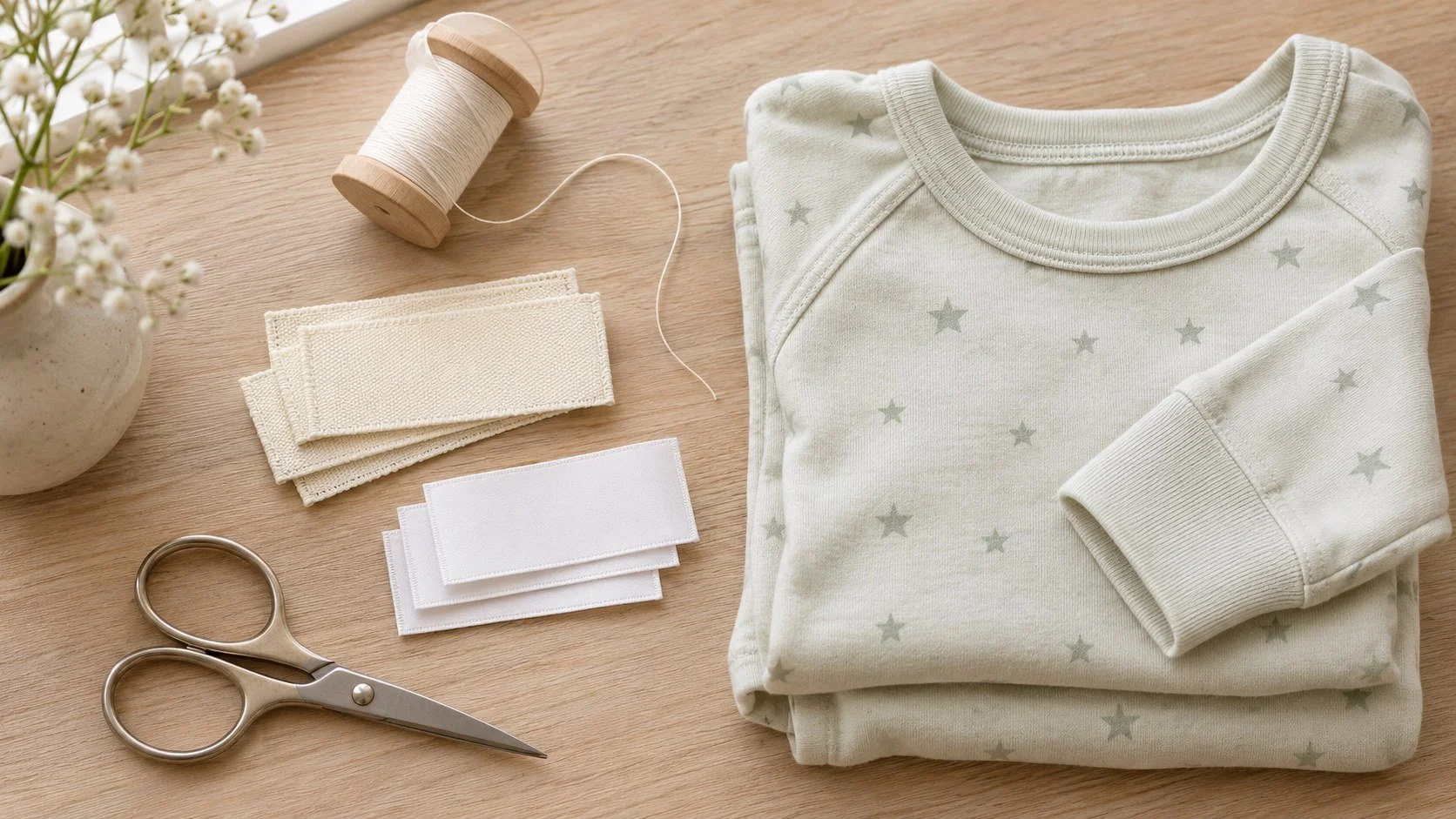
"What goes on the tracking label?": the question we get at label sign-off
We have been sewing children's garments since 1988, and this question often arrives late. A brand approves its main and care labels, then asks where the tracking information goes. Sometimes the plan was a hangtag.
Timing matters because label artwork (fiber content, care and tracking fields) is approved in the tech pack before bulk cutting. After that, a change costs days. This guide puts every label in one place. For the wider picture, start with our CPSIA compliance guide for children's apparel.
What is a CPSIA tracking label?
Section 14(a)(5) of the Consumer Product Safety Act, as amended by section 103 of the CPSIA, requires children's products to bear "distinguishing marks," generally called tracking labels. CPSC defines a children's product as one designed or intended primarily for children 12 years of age or younger, so kids' clothing is in scope.
Who is responsible. Per CPSC, the domestic manufacturer for products made in the US, and the importer for products made overseas.
Not a testing rule. CPSC says the tracking label is not a safety rule requiring certification, with no third-party lab assessment. Your Children's Product Certificate (CPC) does not need to reference it, though a CPC is still required where other children's product safety rules apply.
It can share space. CPSC says marks used for other federal rules can be used or supplemented, and "label" does not mean all information in one discrete location.
What a CPSIA tracking label must include
CPSC says the marks must be "visible and legible" and let a buyer ascertain:
The name of the manufacturer, importer or private labeler.
The location and date of production.
Manufacturing process information, such as a batch or run number, or other identifying characteristics.
Any other information that helps identify the specific source.
CPSC's guidance on the details:
Date. Month and year satisfy it. A date range is acceptable for longer runs. For assembled or packaged items, use the date of assembly or packaging.
Location. The country plus the city and state (or province).
Codes. Allowed "as long as the consumer knows who to contact in order to interpret the code." A code plus website works, "provided the name of a manufacturer, importer, or private labeler is also identified."
Product and packaging: where the tracking label goes on a garment
CPSC says the marks must be "permanently affixed to the product and its packaging, to the extent practicable."
Permanent means "a mark that can reasonably be expected to remain on the product during the useful life of the product."
Textile items. CPSC: "Hangtags and adhesive labels are not permanent for these products." On a garment, tracking information belongs on a sewn-in label.
Packaging. Disposable packaging only needs the mark to last until the consumer receives it, so adhesive can suffice on a polybag.
Clear packaging. If the tracking information is visible through it, CPSC says you need not repeat it outside.
"To the extent practicable." Departures only "for considered and definable reasons," documented in writing.
Sets and socks. For multi-piece sets, one piece or the reusable container can suffice. Children's socks need no label on the sock, but the packaging "must still bear the required tracking information."
The other labels on the same garment: FTC fiber, origin, RN and care
Textile Act label
According to the FTC, most textile products need a label showing fiber content, country of origin and the manufacturer or dealer's identity (company name or RN).
On garments with a neck, the country of origin must be on the front of a label at the inside center of the neck. Fiber content and identity may go on the back of a label.
Fibers use generic names and percentages by weight. Rayon may be called "viscose" or "rayon." Working with bamboo? Read what to ask your supplier about bamboo rayon.
Generally only fibers of 5% or more are named; the rest are "other fiber(s)." A smaller fiber with a functional purpose, such as spandex for elasticity, may be named.
Imported products name the country where processed or manufactured, for example "Made in Mexico."
Information must be "clearly legible, conspicuous and readily accessible," and the label securely attached until delivery to the consumer.
Note the durability difference. The Textile Act label must last until delivery; the tracking and care labels must last the useful life of the garment.
What is an RN number?
An RN is a registered identification number issued by the FTC that can replace your company name on the Textile Act label. The FTC says "An RN is not required," it is free, you apply online, and it is only issued to US-located businesses that manufacture, import, distribute or sell textile, wool or fur products.
Care label
Under the FTC Care Labeling Rule, covered apparel needs complete regular care instructions attached "permanently and securely," legible for the useful life of the product: washing, drying, ironing if regularly needed, and bleach ("No bleach" if none is safe), plus warnings where a step would cause harm. ASTM symbols may replace words if they meet the Rule, and manufacturers and importers need "a reasonable basis" for the instructions.
Snug-fit sleepwear adds more labels
Children's sleepwear at Tobimax goes snug-fit, with no flame retardants. CPSC's sleepwear rule (16 CFR 1615.1) excludes tight-fitting garments from its definition of children's sleepwear, so the flammability tests do not apply, but they must meet dimension limits and these label rules:
Size label by age in months or child's size, also on the package if not visible at retail.
Sewn-in line. "WEAR SNUG-FITTING, NOT FLAME RESISTANT" on the front of the size label at center back, directly below the size, at least 5-point sans serif capitals, line border, contrasting, not covered by any other label.
Yellow hangtag. "For child's safety, garment should fit snugly. This garment is not flame resistant. Loose-fitting garment is more likely to catch fire." One side shows only this message; the reverse may show sizing but is otherwise blank. 1½ x 6¼ inch tag, 18-point Arial or Helvetica, black on Standard Safety Yellow.
Package label with the same message, 11-point, black on yellow. It may be adhesive.
More in snug-fit vs flame-resistant children's pajamas and our sleepwear flammability standards guide.
The label map for a kids' pajama
Every label on a snug-fit pajama, as we would walk through it with you:
Tracking information (CPSA 14(a)(5), CPSC). Company name, country plus city and state or province, month and year, lot. Sewn in at the neckline or side seam, repeated on the polybag or carton where practicable. Permanent.
Textile Act label (FTC). Fiber content, country of origin, company name or RN. Origin on the front of the inside center neck label. Securely attached until delivery.
Care label (FTC Care Labeling Rule). Washing, drying, ironing, bleach. Permanent.
Size label with snug-fit line (16 CFR 1615.1). Size, then the WEAR SNUG-FITTING line directly below, at center back. Sewn in.
Yellow hangtag (16 CFR 1615.1). Safety message only. Removable, so it never carries the tracking information.
Package label. Snug-fit message plus the tracking fields. Adhesive is fine.
CPSIA tracking label example for a toddler pajama
This is an illustration with placeholder names. CPSC itself says: "The Commission has not provided specifications or drafted a sample tracking label."
Center back neck label (front)
Size 2T
WEAR SNUG-FITTING, NOT FLAME RESISTANT
Made in China
Side seam label
95% Cotton, 5% Spandex
Machine wash cold. Tumble dry low. No bleach. Do not iron.
Example Brand LLC
Made in [City], [Province], China, MM/YYYY
Lot: [code]
Polybag sticker
Example Brand LLC, examplebrand.com
Made in [City], [Province], China, MM/YYYY, Lot: [code]
Yellow package label with the snug-fit message
The company name sits beside the code and website on every version.
How the label gets made: from tech pack to sewn-in
The labels section of a tech pack lists main and care label type, content, fold and exact placement, measured from a landmark. Left blank, labels go where the factory usually puts them. Our tech pack template covers it section by section.
Label artwork, tracking fields included, is approved in the tech pack before bulk cutting.
Label guides commonly recommend giving suppliers a print-ready .ai or .eps file with placement, color and size.
The lot identifier comes from the factory's production run.
The label is sewn in at the neckline or side seam, with fields repeated on the polybag or carton where practicable.
The factory hands over the Intertek or SGS test reports, the date and place of manufacture and the lot identifier. The importer drafts and issues the CPC; Tobimax does not issue it.
Amazon, retailers and what happens if the label is wrong
Label guides and marketplaces commonly ask for photos or files of tracking labels before listing US children's products, so keep photos on file.
The bigger reason is traceability. CPSC notes tracking labels can help identify other products containing the same component when a component is linked to a hazard. A clean date and lot on every unit lets a brand narrow which units share a batch. Our post on children's sleepwear recalls shows why.
Checklist before bulk cutting
Tracking fields written out: company, country, city and state or province, month and year, lot
Tracking information sewn in, not on a hangtag or sticker
Country of origin on the front of the inside center neck label
Generic fiber names with percentages
Snug-fit line, yellow hangtag and package label artwork ready
Packaging repeats the tracking fields where practicable, and any exception documented
FAQ
Do I need a new tracking label for every production order?
CPSC says the label must let a buyer ascertain the date and the batch or run, so each run's date and lot must be identifiable. Firms need not create a new numbering system if theirs already identifies the product.
Can the tracking label be a hangtag or sticker?
Not on the garment. CPSC says hangtags and adhesive labels are not permanent for textile products. Adhesive can work on disposable packaging.
Does a small brand need a tracking label?
Yes. CPSC: "There is no exemption or exception from the tracking label requirement based on the size of the business."
What is an RN number, and does my brand need one?
An optional, free FTC number for US businesses that can replace your company name on the Textile Act label. CPSC says an RN "may satisfy part of the tracking label requirement," but not all of it. On the tracking label, CPSC accepts a code or website only when the company name is also identified, so keep your name there.
Does CPSC approve tracking labels or give a template?
No. CPSC has not set specifications or drafted a sample tracking label.
Next step
Two generations strong, we treat labels as part of the garment. MOQ is 400 units per style in China, and bulk production is 60 days from approved sample, plus about 6 weeks if fabric is not in stock. See our sleepwear manufacturing, or request a quote and send your label artwork with your tech pack, so every field is settled before bulk cutting.