
Tech Pack Template: Every Section, the Fields a Factory Reads First, and a Filled Example
By Tanya Lee, VP, Tobimax Textiles
A tech pack template is the blank version of the document a factory builds a garment from. The sections are a cover sheet, technical flats, a bill of materials, points of measure with grading and tolerances, construction callouts, labels and packaging, colourways, compliance notes and a revision history. The headings are easy. The fields inside them decide your first sample.
For the definition, read our post on what a tech pack is. This post is the worksheet: the fields in each section, what a factory does when one is blank, and a filled example from an anonymised baby bodysuit.
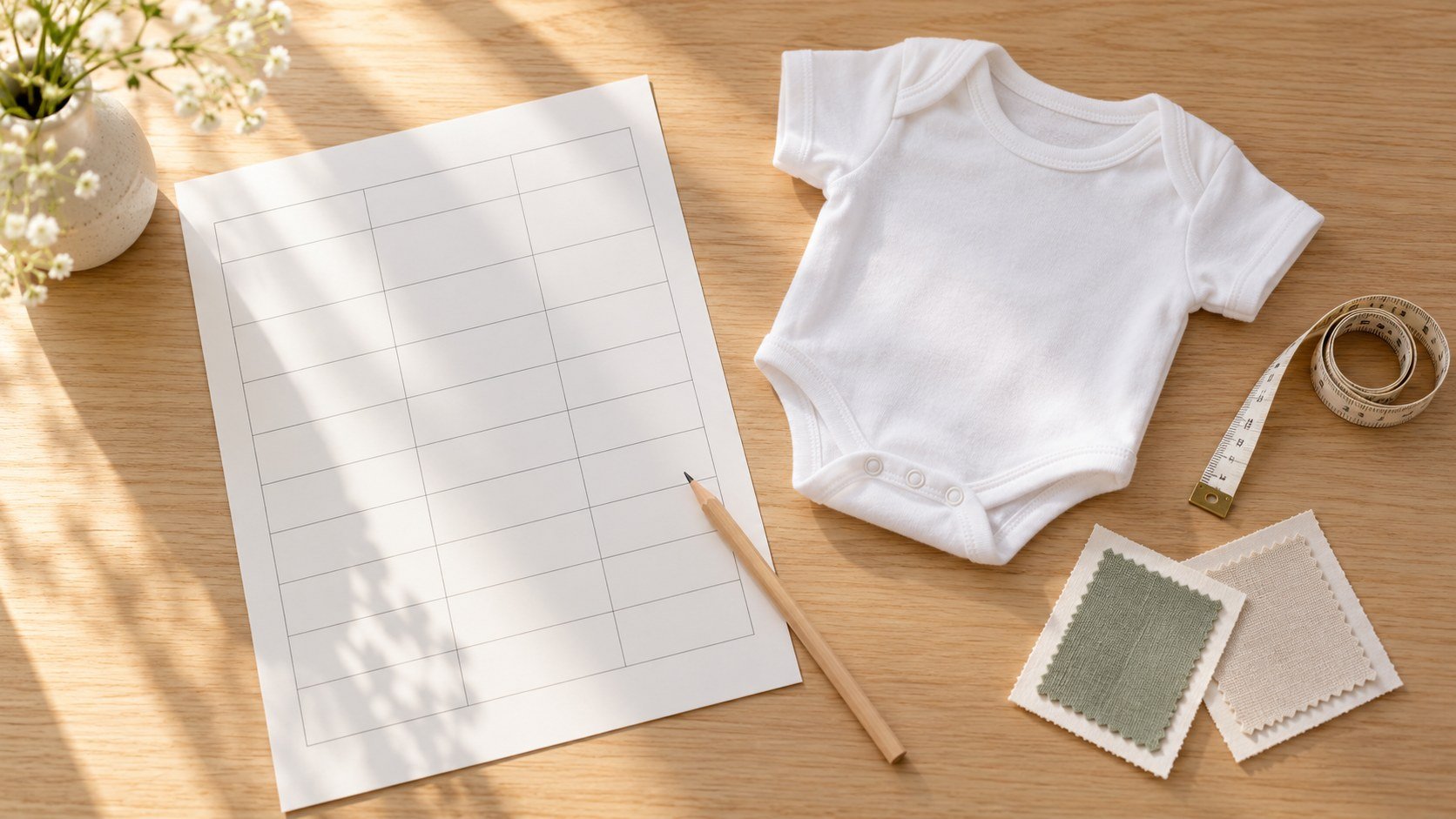
Why most tech pack templates still lead to a wrong first sample
The pattern we see most from the factory side. A founder downloads a blank template, fills the boxes with "soft cotton", "snaps at crotch" and "standard stitching", and sends it off. Every heading has something under it, so the document looks finished.
The factory treats it that way. It assumes the brand knows what it wants, builds to its own defaults for anything unspecified, and ships the sample. "Soft cotton" becomes whatever jersey is on the shelf.
Each extra round is another prototype fee and about 3 more weeks. At Tobimax, sampling is $95 per prototype with one revision included and about 3 weeks per round, so two avoidable rounds is another $190 and roughly six weeks. The template was never the problem. The empty fields behind the headings were.
The tech pack template, section by section
For each section: the fields a manufacturer reads first, then what gets defaulted if you leave it blank. Copy these lists into any spreadsheet or document and you have the structure.
1. Cover sheet and style summary
Style name and style number (what the factory files and quotes against)
Season and base size (the size the sample will be sewn in)
Garment category, one-line description, date and revision letter
If blank: the factory picks its own base size, and every measurement conversation has to be translated.
2. Technical flats (front, back, detail callouts)
Front and back flats in line art, not fashion illustrations
Detail callouts with arrows: closures, seam lines, topstitching, pockets, binding, neck and hem finish
If blank or photo-only: the pattern maker reads proportions off the picture, and your "slim" becomes the house block.
3. Bill of materials
Body fabric: fibre content, construction (jersey, interlock, rib, woven), weight in gsm, finish, any certification required on the finished fabric
Secondary fabrics (rib, binding, lining) with the same fields
Thread: type and size for needle and looper
Trims: closure type, size, material and finish
Labels: woven, printed, care, hang tag
If blank: fabric weight hurts most. Our guide to fabric weight in gsm explains why "lightweight cotton" can land anywhere. Leave the number out and the factory writes it for you.
4. Points of measure, grading and tolerances
A numbered list of points of measure (POMs), each with how it is taken (half or flat, relaxed or extended)
The base size value and the graded value for every size in the run
A tolerance for every POM, and which POMs are critical
If blank: the factory grades with its own increments, and your 6M and 18M end up proportioned like someone else's brand.
5. Construction and stitch callouts
Seam type and stitch class for each seam group (ISO numbers remove guesswork)
Stitches per inch (SPI) as a range
Needle size and type for the fabric
Seam allowance
Reinforcements: tape, bartacks, 2-ply areas
If blank: the line uses its default class and SPI. On a knit, that can mean a seam that pops when the garment stretches.
6. Labels, artwork placement and packaging
Main label and care label: type, content, fold, exact placement
Artwork: method, placement measured from a landmark, size, colours
Folding, polybag and carton instructions
If blank: labels go where the factory usually puts them and artwork is centred by eye.
7. Colourways
Colourway name and reference per body fabric
Thread, trim and label colour per colourway (tonal or contrast)
If blank: thread and trims default to black or white.
8. Safety and compliance callouts (baby and kids)
For anything sold for babies or children in the US, these are the rules a kids tech pack should call out, as published by the CPSC and FTC:
Small parts: 16 CFR 1501 is the CPSC small parts rule for products meant for children under 3. The CPSC exempts children's clothing and its buttons from that rule, but expects fasteners to stay secure, so the pack specifies snap reinforcement and a 15 lbf pull test on snaps and trims
Lead and phthalates: CPSIA limits total lead in accessible components such as snaps to 100 ppm, and surface coatings such as plastisol prints to 90 ppm. Phthalate limits apply to child care articles, which includes sleepwear for children 3 and under. Third-party testing with a Children's Product Certificate covers both
Tracking label: CPSIA Section 103 permanent tracking label with manufacturer, location, date and batch
Care and content: FTC rules at 16 CFR 303 and 423 for a permanent label with fibre percentages, country of origin, RN and care instructions
Sleepwear: if marketed as sleepwear, 16 CFR 1615 and 1616 apply, or the tight-fitting exemption. Our post on children's sleepwear flammability standards covers both routes. Tobimax builds children's sleepwear snug-fit, with no flame retardants.
If blank: the factory is not your compliance team. A missing tracking label is found at the customs broker, not at the sewing line. Always confirm current requirements with the CPSC and FTC for your specific product.
9. Revision history
Revision letter, date, who changed it and what changed, one line per revision
If blank: two versions circulate and the sample is built from the older one.
Filled example: a baby bodysuit tech pack, blank wording vs factory-ready wording
Drawn from the anonymised sample pack on our Tech Pack Studio site: a baby bodysuit, style TBX-ONE-001, base size 12M, revision A. No client is named.
Body fabric
Blank template wording: "Soft cotton"
Factory-ready wording: Cotton jersey, 180 gsm, OEKO-TEX, whole body. Neck binding in 1x1 rib, self colour.
Seams
Blank template wording: "Standard stitching"
Factory-ready wording: ISO 514 4-thread overlock at 12 to 14 SPI on all seams, shoulders stay-taped. Seam allowance about 1 cm. Seams stretch to the fabric's full extension.
Thread and needle
Blank template wording: "Matching thread"
Factory-ready wording: Needle thread core-spun polyester Tex 24, tonal, all seams. Looper thread textured polyester for overlock and coverstitch. Needle 70/10 ballpoint for jersey.
Closures
Blank template wording: "Snaps at crotch"
Factory-ready wording: Three nickel-free metal snaps, 9.5 mm, at the crotch, set through 2-ply reinforcement, pass a 15 lbf pull test.
Neckline and hems
Blank template wording: "Finished neck and hems"
Factory-ready wording: Neckline rib binding, 504 plus coverstitch, band undercut to lay flat. Sleeve and leg hems 406 coverstitch.
Notice what changed. Not the headings. The right column simply refuses to leave a decision to the factory.
What a blank template cannot give you
A template is structure. Three things are knowledge, and no blank document carries them:
Graded measurements and tolerances for your size run. The template does not know how much a chest grows between 6M and 12M.
Stitch classes for your fabric. A 180 gsm jersey, a 1x1 rib and a woven poplin each want different seams, SPI and needles.
Construction and reinforcement. Where a shoulder needs tape, where a snap needs a second ply, which seams must stretch.
This is where a technical designer, or a studio like ours, takes over from the spreadsheet.
Template, technical designer or Tech Pack Studio: which route fits your stage
The template alone fits a founder who already has a graded spec from a previous run.
A technical designer fits a brand developing many styles a season with a house block to maintain.
The Tech Pack Studio fits a baby or kids brand with a clear idea and no graded spec yet. You build the spec in a guided builder (garment, sizes, fabric, neckline, trims, with a live flat that redraws as you go), and a Tobimax designer reviews it and emails a factory-ready pack within 3 to 5 business days.
Studio pricing is $800 for a Development Pack (flats front and back, graded measurements, bill of materials, basic construction, colourways, one revision) and $1,500 for a Production Tech Pack (everything in Development plus full grading with tolerances, stitch and seam callouts, labels, artwork placement, a safety and compliance review, up to two revisions). The fee is not credited against a production order. The pack is fully your IP, a neutral spec with no company names, no Tobimax branding and no MOQ, lead time or costing inside, so you can produce it with us or any factory.
What a complete template saves you in sampling
A closer first sample. When the pack specifies gsm, stitch class, SPI, trim size and tolerances, the first $95 prototype is built to your spec, not the factory's defaults.
Fewer rounds. Every round you avoid is $95 and about 3 weeks kept. Sampling to bulk-ready runs about 2 months with a complete pack.
A quote that matches the garment. A quote built from "soft cotton" is a guess. One built from 180 gsm OEKO-TEX cotton jersey and 9.5 mm nickel-free snaps is a number you can plan around. Honest pricing starts with an honest spec.
Consistent reorders. Once a sample is approved, bulk production is 60 days (garment production only), plus about 6 weeks if the fabric is not in stock, and the same pack drives every reorder.
We have been building garments from tech packs since 1988, two generations strong, and the packs that produce clean first samples are never the longest ones. They are the ones with no empty fields.
FAQ
Is there a free tech pack template I can use?
Yes. The nine sections and field lists in this post are the template. Copy them into any spreadsheet or document and fill every field before you send it. The Tech Pack Studio sample shows a filled version of the same structure.
What format should a tech pack template be in?
Any format the factory can open and print. Most brands send a PDF for flats, construction and labelling, with the measurements in a spreadsheet. Word, Excel, Google Sheets, PDF and Illustrator are all common.
What is the difference between a tech pack template and a tech pack example?
A template is the empty structure. An example is one style filled in from top to bottom. The example in our what is a tech pack post and the Tech Pack Studio bodysuit are both examples.
Do I need a different template for each garment type?
No. The nine sections are the same for a bodysuit, a pyjama set or a hoodie. What changes inside them is the POM list, the construction callouts and, for baby and kids garments, the compliance block.
Can I send a filled template to Tobimax for a quote?
Yes, through our quote request page. Our MOQ is 400 units per style at the China factory, and 3,000 per style in Vietnam for high-volume programs. Sampling is $95 per prototype with one revision included.
Next step
If you have a filled pack, request a quote and we will price it against the spec you wrote. If you have an idea and an empty template, the Tech Pack Studio sample shows what the nine sections look like with every field answered. Either way, welcome to the family.