
What Is Bamboo Rayon? A Manufacturer's Guide for Apparel Brands
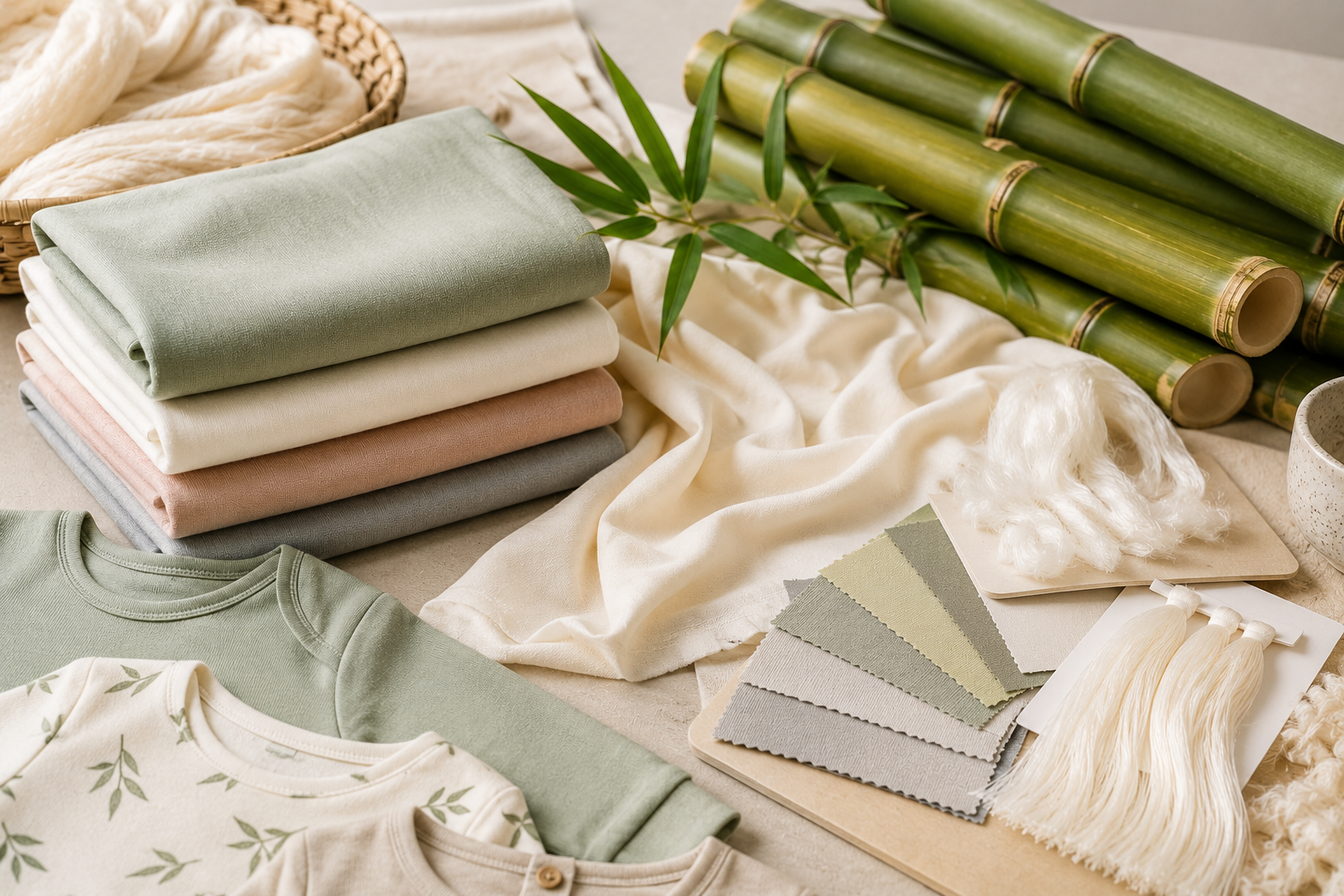
Bamboo rayon is a regenerated cellulose fibre made by dissolving bamboo pulp and spinning it into yarn. It is semi-synthetic: the source is a plant, but the fibre is created by a chemical process. It is made by two routes, viscose or lyocell, and the route changes the fabric, the chemistry and the price.
Here is the problem we see most often. A founder collects three quotes for "bamboo" fabric, and none of them says which route it is. Then the label they print says "bamboo", which the FTC does not allow. This guide walks through what bamboo rayon is, how it is made, how to label it, and what to ask before you sample.
What is bamboo rayon? (and is it a natural fiber?)
Bamboo rayon starts as bamboo, but it does not stay bamboo. The plant is broken down to pulp, the cellulose is dissolved, and a new fibre is formed from that solution. That is why it is called a regenerated fibre.
So is bamboo rayon natural or synthetic? Neither, strictly. It is usually described as semi-synthetic. It is not a natural fibre like cotton or linen, because the plant structure is destroyed in processing. It is not a synthetic like polyester either, because it is made from plant cellulose rather than petroleum.
A useful detail for buyers: the words "rayon" and "viscose" on a label do not always mean bamboo. The same process is used with beech, pine and eucalyptus pulp. Bamboo is one source among several.
What bamboo rayon is NOT:
Not "bamboo fibre". True bamboo fibre is extracted mechanically, the way linen comes from flax. It is rare and coarse. Almost no garments sold as "bamboo" use it. Most are rayon.
Not antibacterial because it is bamboo. The raw plant has antibacterial compounds, but they are not retained through rayon processing. Antibacterial claims on bamboo rayon usually come from a separate finishing treatment, not from the bamboo.
How bamboo rayon is made, step by step
The steps are the same whichever route the mill runs. The difference sits in step 3.
Harvest. Bamboo is cut and prepared for processing.
Pulp. The stalks are broken down into a cellulose pulp.
Dissolve. The pulp is dissolved in a solvent. The viscose route uses carbon disulfide. The lyocell route uses NMMO (N-Methylmorpholine N-oxide).
Extrude. The cellulose solution is pushed through a spinneret, a plate with fine holes, to form filaments.
Spin. The filaments are spun into yarn.
Knit or weave. The yarn becomes jersey, rib, interlock or a woven fabric.
Dye and finish. The fabric is dyed and finished, and this is where any added performance treatment would be applied.
Bamboo rayon vs bamboo viscose vs bamboo lyocell
Start with the naming, because this is where most of the confusion lives. "Rayon" and "viscose" are used for the same fibre. Bamboo rayon and bamboo viscose are, in practice, the same thing. Bamboo lyocell is the one that differs, because it is made by a different process.
Open-loop viscose (conventional bamboo rayon):
Uses carbon disulfide as the dissolving solvent
Solvent recovery is typically about half or less
The rest leaves the process as effluent or vapour
This is the route most low-cost "bamboo" garments use
Closed-loop lyocell (bamboo lyocell):
Uses NMMO as the solvent
Solvent recovery is 99%+
Closed-loop processing keeps environmental discharge low
The same lyocell process used for wood-pulp lyocell fibres
Costs more than bamboo viscose
A garment described only as "bamboo" could be either route. If you are weighing bamboo against other soft cellulose fabrics, our bamboo vs modal vs lyocell comparison for sleepwear goes deeper on that choice.
How to label bamboo rayon: "rayon made from bamboo"
According to the FTC, textiles made of rayon derived from bamboo must be labelled and advertised as rayon, not as "bamboo". Wording such as "rayon made from bamboo" or "viscose made from bamboo" names the fibre correctly and still tells the customer where it came from. What you cannot do is call the fabric simply "bamboo".
The FTC also says the environmental benefits of the bamboo plant do not carry over to the finished fabric, because rayon manufacturing uses toxic chemicals. So claims like "eco-friendly because it is bamboo" are a risk on rayon products.
This is not theoretical. In April 2022, the FTC announced that Kohl's agreed to a $2.5 million civil penalty and Walmart a $3 million civil penalty over textiles marketed as "bamboo" that were rayon. Both had received FTC warning letters in 2010.
We are a manufacturer, not a law firm, so treat this as background rather than legal advice. Before you print care labels or write product pages, confirm the exact wording with your compliance lab.
What bamboo rayon fabric feels and performs like
Brands choose bamboo rayon for how it wears, so here are both sides.
Why brands like it:
Softness. A smooth, soft hand that customers notice in sleepwear and baby basics.
Drape. It falls and moves rather than holding a stiff shape.
Cool touch. It feels cool against the skin, which suits sleepwear.
Moisture handling and breathability. It handles moisture well and wears comfortably in warm conditions.
What to plan for:
Shrinkage. It can shrink if the fabric is not pre-shrunk. Ask your supplier whether it is pre-shrunk and what the shrinkage tolerance is after wash, before you grade sizes.
Lower wet strength. It is weaker when wet, which affects washing and handling.
Pilling. Some knits can pill, depending on construction.
Care labels matter. Your care instructions have a real effect on how the garment holds up.
Blends. A 100% bamboo rayon fabric gives the softest drape. A bamboo rayon and spandex blend adds stretch and recovery, which helps fitted sleepwear and baby pieces keep their shape.
A first-hand data point from our own production: a 90.5% bamboo rayon and 9.5% spandex knit we produce tested UPF 50+ at SGS to AATCC 183, from the fabric construction, with no UV finish. One caution, UPF is colour dependent, so each new colour needs its own test.
If you are deciding between bamboo and cotton for a sleepwear line, see our honest comparison of bamboo vs cotton pajamas.
Certifications bamboo rayon can and can't carry
GOTS: A bamboo rayon garment cannot be certified to GOTS as organic. GOTS treats regenerated cellulose fibres such as viscose and lyocell only as a limited minority fibre in a blend.
OEKO-TEX Standard 100: Yes. This applies to the finished fabric and is the certificate to ask for on your order.
bluesign: Yes, at the facility level. Ask whether the processing facility is bluesign certified.
These certificates tell you about finished fabric safety and the facility. None of them tells you whether your fabric was made by closed-loop lyocell or open-loop viscose. You have to ask.
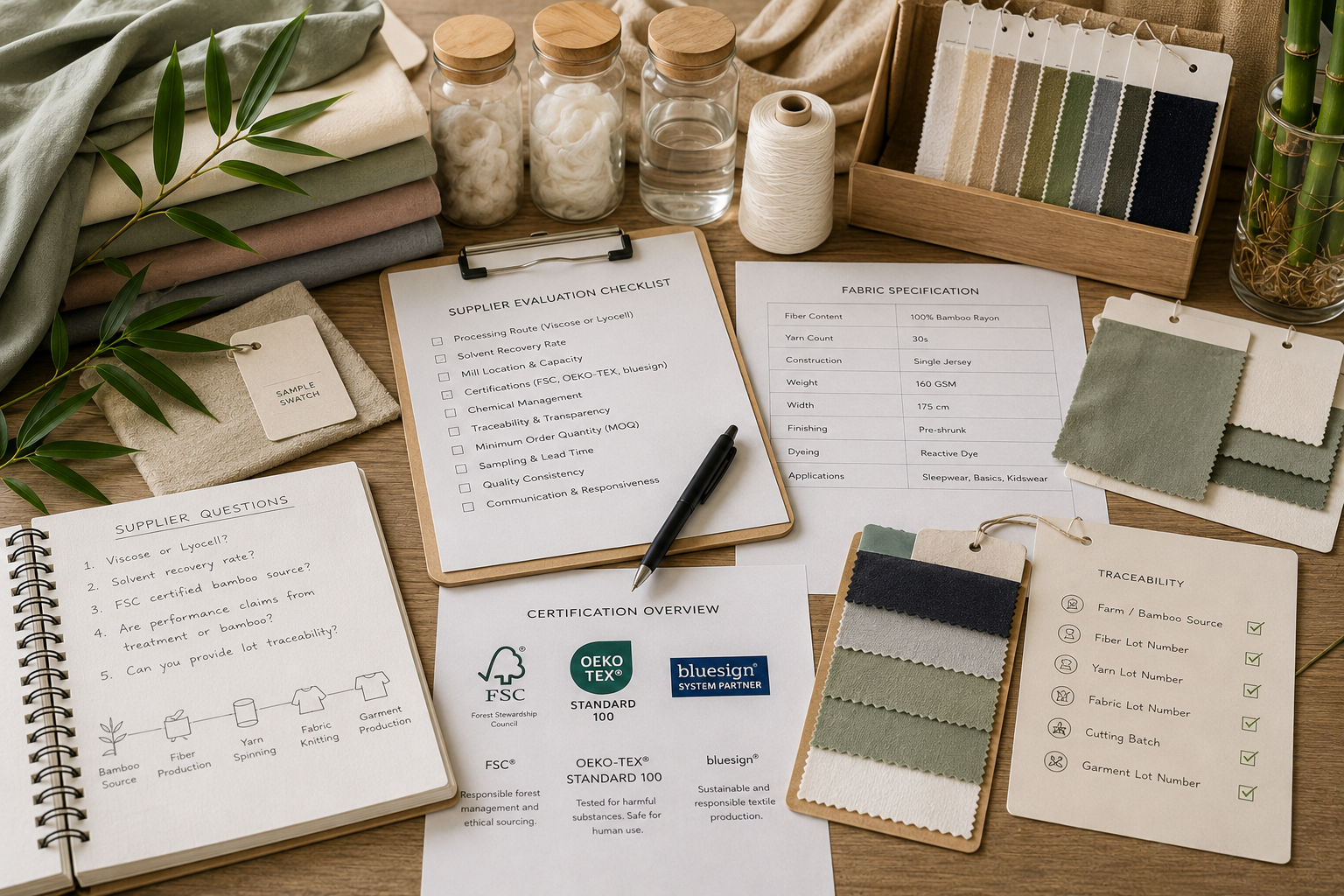
5 questions to ask your bamboo rayon supplier
1. "Is your bamboo rayon viscose or lyocell?" This single question filters out most greenwash. A real factory will answer straight away. If the answer is "we offer both", ask which route applies to your specific order before sampling.
2. "Is the processing facility bluesign certified, and can I see the OEKO-TEX Standard 100 certificate for the finished fabric?" Ask for documents, not a verbal yes.
3. "Where does the bamboo come from, and does the source carry any forest certification?" You may not get a mill name, but you should get a straight answer about the source.
4. "Is the antibacterial, UV or wicking claim from the bamboo itself, or from a finish?" The raw plant's compounds do not survive rayon processing, so a claim that rests on "it is bamboo" is marketing. If it comes from a finish, ask what the finish is and whether the finished fabric carries OEKO-TEX Standard 100. For UV, ask for the UPF test report and the colour it was tested in.
5. "What lot traceability can you give me from finished garment back to fabric?" Ask how yarn lots, fabric lots and cutting batches are recorded on your order.
How Tobimax produces bamboo rayon (both routes)
We make bamboo rayon by both routes, closed-loop lyocell and open-loop viscose, because the right answer depends on the brand brief. Both carry OEKO-TEX Standard 100 on the finished fabric and are processed at bluesign certified facilities.
How brands choose:
Bamboo lyocell when the brand's positioning leads with sustainability, or when a retail buyer requires closed-loop processing, and the price point supports it.
Bamboo viscose when the brand puts cost per unit and softness first.
Whichever you choose, write the route on the fabric line of your tech pack, for example "rayon made from bamboo, viscose route" or "bamboo lyocell", along with the blend and weight. That way the factory, the lab and your label all say the same thing. Our guide to what goes into a tech pack shows where it sits.
The numbers, so you can plan:
MOQ: 400 units per style at our China factory. Order more than 2 styles and you can split into 2 colours x 200 per style; otherwise it is 400 per colour. Our Vietnam factory runs 3,000 per style for high-volume programs only.
Sampling: $95 per prototype with 1 revision, about 3 weeks per sample round.
Bulk production: 60 days from approved sample for garment production, plus about 6 weeks when the fabric is not in stock.
For children's sleepwear in bamboo, we build snug fit and use no flame retardants. Our children's sleepwear flammability and CPSIA guide explains why snug fit matters.
New to working with a factory on your own label? Our guide to choosing a private label clothing manufacturer covers the wider process.
FAQ
Is bamboo rayon a natural fiber?
No. Bamboo rayon is a regenerated cellulose fibre, usually described as semi-synthetic. It comes from a plant, but the plant is dissolved and the fibre is re-formed by a chemical process, so it is not natural like cotton or linen, and it is not a petroleum synthetic like polyester.
Is bamboo rayon the same as bamboo viscose?
In practice, yes. "Rayon" and "viscose" are used for the same fibre. Bamboo lyocell is the different one, made by a closed-loop process with NMMO solvent and 99%+ solvent recovery.
Why do labels say "rayon made from bamboo"?
Because the FTC says textiles made of rayon derived from bamboo must be labelled and advertised as rayon, not "bamboo". Wording such as "rayon made from bamboo" or "viscose made from bamboo" is the form the FTC describes. Confirm final wording with your compliance lab.
Can bamboo rayon be GOTS certified?
Not as organic. GOTS treats regenerated cellulose fibres only as a limited minority fibre in a blend, so a bamboo rayon garment cannot be GOTS certified. Look for OEKO-TEX Standard 100 on the finished fabric and bluesign certified processing facilities instead.
What is the MOQ and lead time for bamboo rayon at Tobimax?
400 units per style at our China factory. Bulk production is 60 days from approved sample, plus about 6 weeks if the fabric is not in stock. Sampling is $95 per prototype, about 3 weeks per round.
Start your bamboo rayon program
Tobimax has made garments since 1988. We were founded by Tony Lee and his brother Eddie Lee, and we are two generations strong. We will tell you which route your bamboo rayon is, put it on your tech pack, and quote it with honest pricing. When you are ready, request a quote and tell us about your styles, fabric and quantities.
Tanya Lee, VP, Tobimax Textiles. Sources: FTC bamboo guidance (ftc.gov/bamboo) and FTC press release, April 2022.