
What Is a Tech Pack? A Manufacturer's Guide for Brands
A tech pack is the technical document a factory builds your garment from. It holds the flat drawings, bill of materials, graded measurements with tolerances, construction notes, labels and colourways in one place. Without it, the factory fills the gaps with guesses, and every wrong guess costs you another sample round.
What is a tech pack?
Think of a tech pack as the single source of truth between a brand and its manufacturer. Your designer knows what the garment should feel like. Your factory knows how to sew it. The tech pack puts both on paper, so nobody relies on memory or a chat thread.
A typical clothing tech pack includes a cover page, front and back technical flats, a bill of materials, a measurement spec with grading, construction notes, colourways, artwork placement and a revision history. Some brands add a cost sheet. The job is always the same, to describe the product so completely that two factories would make the same thing.
Why a sketch is not enough (the problem we see from the factory side)
We have been making garments since 1988, and the most common first message from a new brand looks like this: a sketch, a few reference photos and a size chart. It is a good start. It is not something a factory can build from.
Here is what that package usually leaves open:
Fabric. "Soft cotton" could mean a dozen different weights and knits. Weight changes drape, shrinkage and cost.
Seams. Is the side seam overlocked, flatlocked or coverstitched? Each gives a different look, stretch and price.
Trims. Snap size, snap finish, how many, and where they sit.
Tolerances. How far a measurement can move before the piece fails inspection.
Labels. Which labels, what they say, and where they go.
When those details are missing, the sample room decides for you, and the first sample often comes back close but wrong. For baby and kids products the bigger risk is not a fit miss. It is a missing compliance callout, such as small parts, the tracking label or the sleepwear route, that nobody flagged because nobody wrote it down.
What goes into a tech pack
A complete tech pack answers every question the factory would otherwise have to ask. These are the sections we look for first when one arrives.
Cover page and style details
The cover page names the style, its style number, season, size range and the date of the current revision. On a reorder, this page confirms everyone is working from the same version.
Technical flats
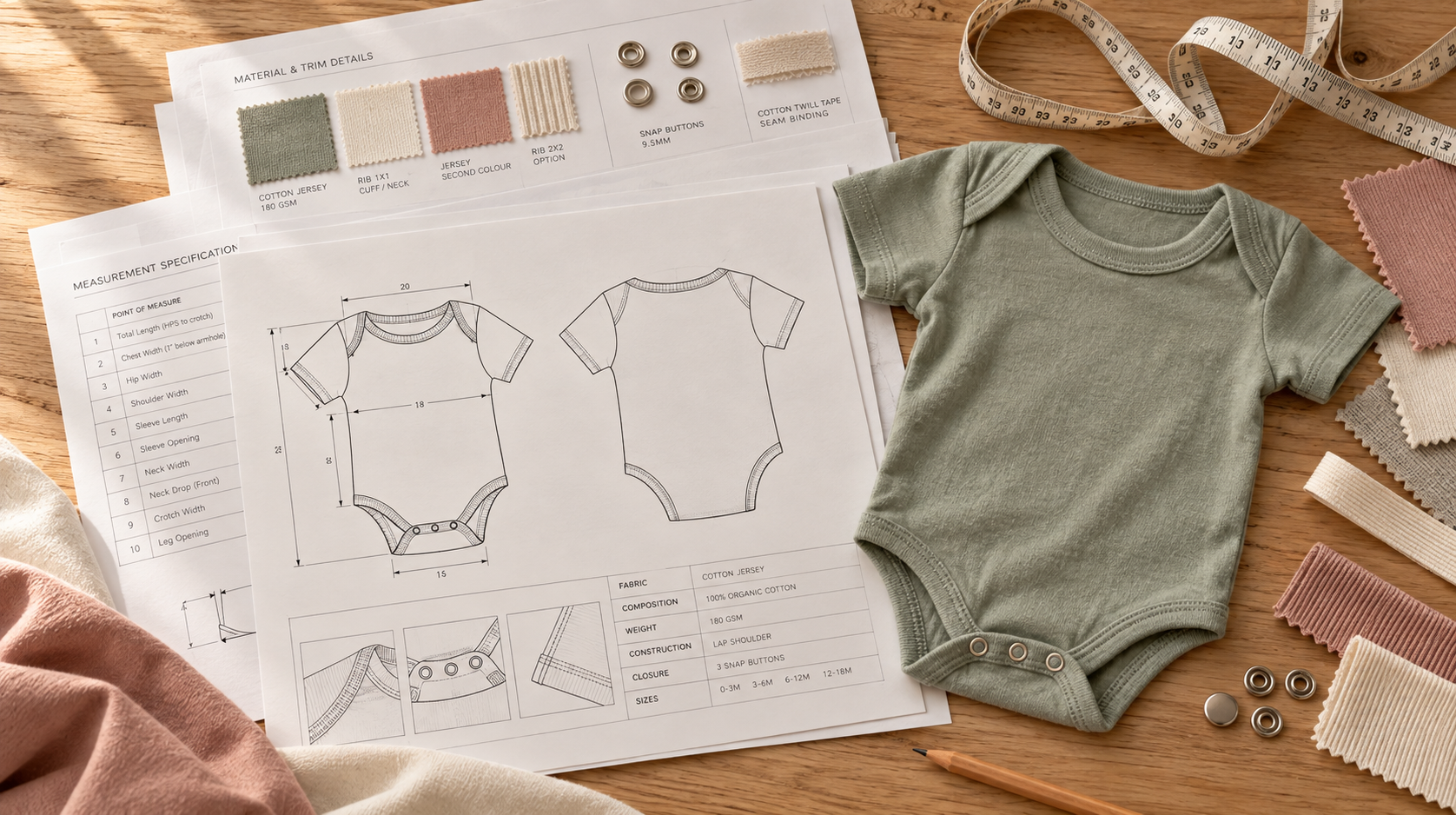
Flats are clean line drawings of the garment, front and back, drawn flat rather than on a body. They show seam lines, stitch lines, closures and details like a lap shoulder or a snap placket. A fashion illustration shows the mood. A flat shows the construction.
Bill of materials
The bill of materials (BOM) lists every component: body fabric with its weight in gsm and content, rib or binding, thread, snaps or buttons, labels and packaging. If fabric weight is new to you, our guide to what GSM means in fabric explains why that one number matters so much. Certifications belong here too, for example GOTS organic cotton or OEKO-TEX Standard 100 on finished fabric, when the brand needs them on the product.
Graded measurements and tolerances
This is the page that decides whether your sizes are consistent. Each point of measure (chest width, body length, sleeve length, neck opening and so on) is listed for every size in the run, and each one carries a tolerance. The packs we build in our studio grade every point of measure across the full size run, for example newborn to 5Y on a baby style, with a tolerance on each line.
Construction, labels and artwork placement
Construction notes name the stitch and seam types, stitches per inch, seam allowances and any reinforcement. Label notes say which labels go where. Artwork placement gives the print or embroidery position measured from a fixed point, such as the high point shoulder or centre front.
Safety and compliance callouts (baby and kids)
For children's products, the tech pack is where safety requirements get written into the build instead of being remembered at the end. These are the US rules a kids tech pack should call out, as set by the CPSC and FTC:
Small parts. 16 CFR 1501 is the small parts rule for products meant for children under 3. The CPSC exempts children's clothing and its buttons from that rule, but expects fasteners to stay secure, and snaps that come off can be a reportable hazard. That is why snap reinforcement and a pull test belong in the pack.
Lead and phthalates. CPSIA limits total lead in accessible components such as snaps and zippers to 100 ppm. Screen prints, including plastisol, count as surface coatings with a 90 ppm lead limit. Phthalate limits apply to child care articles, which includes sleepwear for children 3 and under. Third-party testing and a Children's Product Certificate are part of the process.
Tracking label. CPSIA Section 103 calls for permanent tracking marks on the product and its packaging, where practicable, showing the manufacturer or private labeler, location and date of production, and batch or run.
Care and fibre labels. FTC rules call for a permanent care label (16 CFR 423) and a fibre content label (16 CFR 303) that shows fibre content, country of origin and the company name or RN.
Sleepwear. If the garment is marketed as sleepwear, it follows 16 CFR 1615/1616 or the tight-fitting exemption. Our children's sleepwear goes the snug-fit route, with no flame retardants. You can read more on our sleepwear manufacturing page.
Always confirm the current requirements with the CPSC and FTC for your specific product.
Tech pack example: what "specific enough" looks like
The fastest way to understand a tech pack is to compare two versions of the same note. Here is an anonymized baby bodysuit (lap shoulder, short sleeve, snap crotch) from our studio's sample pack.
What a factory often receives: "Soft cotton, rib neck, snaps at crotch, care label inside."
What a factory can build from:
Body fabric: cotton jersey, 180 gsm, OEKO-TEX.
Neck binding: 1x1 rib, self colour, applied with 504 plus coverstitch.
Seams: ISO 514 4-thread overlock, 12 to 14 SPI, shoulders stay-taped, seam allowance about 1 cm.
Hems: 406 coverstitch.
Needle: 70/10 ballpoint, chosen for jersey.
Thread: core-spun poly Tex 24 needle thread, textured polyester looper thread.
Snaps: nickel-free metal, 9.5 mm, 3 at the crotch, set through 2-ply reinforcement and passing a 15 lbf pull test.
Labels: woven damask label folded at centre back neck. Printed satin care label at the left side seam with fibre, origin and RN.
The second version leaves nothing to interpret. The sample room knows which needle to load, how dense the stitching should be, and how strong the snaps must hold.
Tech pack vs spec sheet
A spec sheet is usually one page, often the measurement and specification page. A tech pack is the full package: the spec sheet plus the flats, the BOM, construction, labels, colourways, artwork and revision history.
Who makes the tech pack, and how long it takes
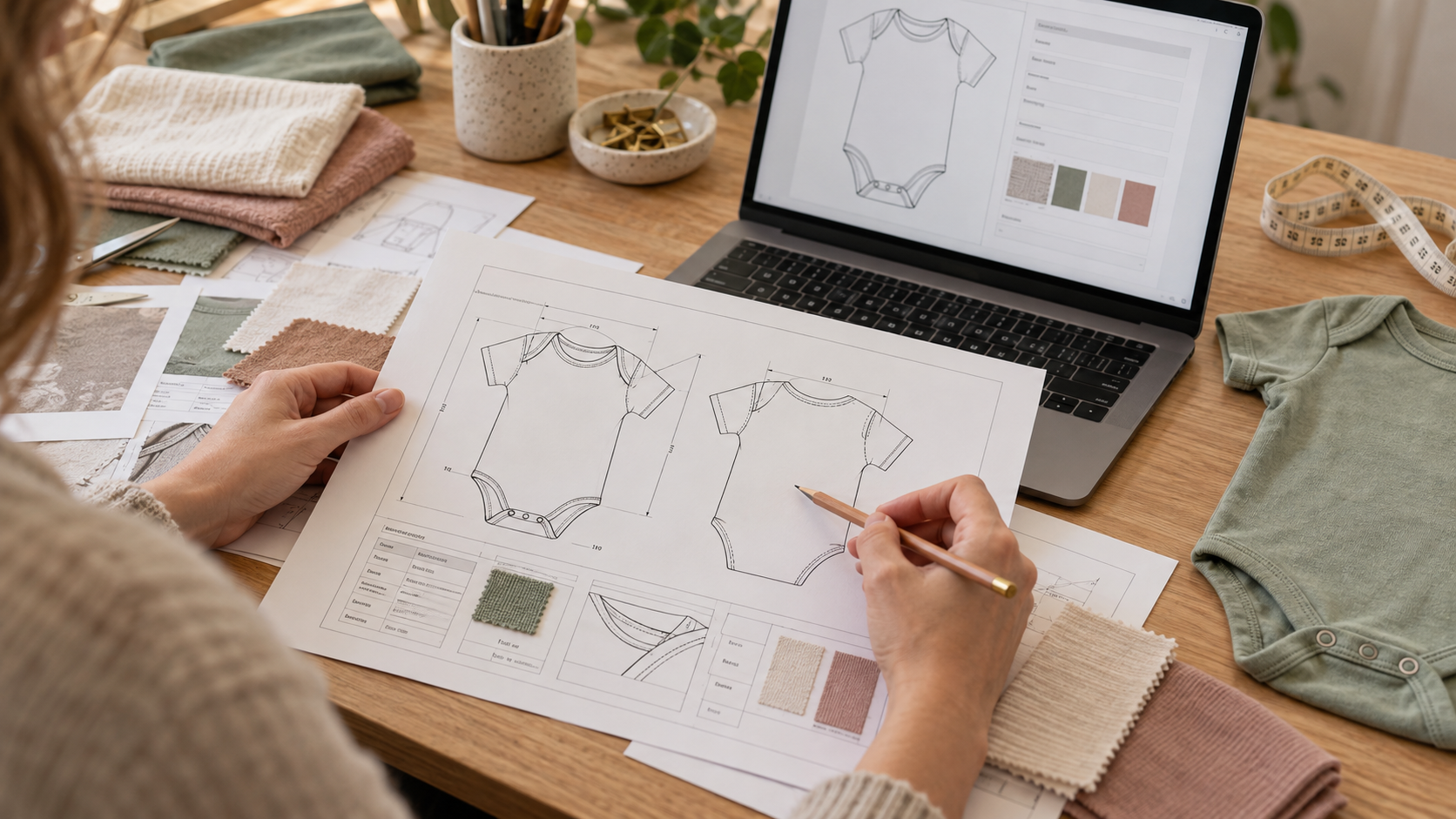
A tech pack can be made by the brand's own designer, a technical designer, the founder working from a template, or a tech pack service. A tech pack template is a fine way to learn the sections. The hard part is knowing which details a factory needs and what realistic values look like.
That is why we built the Tobimax Tech Pack Studio for baby and kids garments. You build your spec in a guided builder (garment, sizes, fabric, neckline, trims) with recommended defaults, then a Tobimax designer reviews and finalizes it into a factory-ready pack, emailed within 3 to 5 business days. Rush options are available.
Two things we hold to on every pack we prepare. First, it is a neutral spec, with no company names, no branding, and no MOQ, lead time or costing inside it. Second, the tech pack is yours. It is your IP, and you can produce it with us or with any factory.
What a missing spec costs you in sampling
Here is where an incomplete tech pack shows up on the invoice. Our sampling terms are $95 per prototype, which includes 1 revision, with about 3 weeks per round and about 2 months to bulk-ready.
Once the included revision is used, every round caused by a missing detail adds another prototype fee and about 3 more weeks. Two extra rounds means two more $95 fees and roughly 6 more weeks before you can approve a sample. And the calendar matters more than the fee, because bulk production of 60 days only starts from the approved sample, plus about 6 weeks if your fabric is not in stock. A late sample pushes everything after it.
A complete pack also keeps your quote honest. When the BOM and construction are fixed, the price you are quoted is the price of the product you will actually receive. If you are still learning how factory pricing works, our guides to MOQ and FOB and CMT manufacturing are good next reads.
Factory-ready tech pack checklist
Before you send your pack to any manufacturer, check that it includes:
Style name, style number, size range and current revision date on the cover page
Front and back technical flats with seam and stitch lines shown
Body fabric with content, knit or weave, and weight in gsm
Every trim listed with size, finish and quantity (snaps, buttons, elastic, binding)
Thread type for needle and looper
Every point of measure graded across the full size run
A tolerance on every measurement
Stitch and seam types, stitches per inch and seam allowance
Reinforcement points (snap areas, shoulders, stress points)
Label list with placement and content (main, care, fibre, origin, RN, tracking)
Artwork or print placement measured from a fixed point
Colourways for every component
Safety and compliance callouts for baby and kids products
A revision history, so everyone works from the same version
FAQ
Do I need a tech pack before contacting a manufacturer?
You can start a conversation without one, and we can help you build it. A complete tech pack is what makes the sample and the quote accurate.
How much does a tech pack cost?
At the Tobimax Tech Pack Studio, a Development Pack is $800. It covers custom technical flats front and back, graded measurements, bill of materials and basic construction, colourways and 1 revision round. A Production Tech Pack is $1,500. It adds full grading with points of measure and tolerances, stitch and seam callouts, labels, artwork placement, a safety and compliance review, and up to 2 revisions. The fee is not credited against a production order.
Who owns the tech pack?
You do. A tech pack we prepare is fully your IP, and you can produce it with Tobimax or any other factory. Your design details are kept confidential.
Can I make a tech pack myself without design software?
Yes. Many founders start with a template and a spreadsheet. The challenge is knowing what the factory needs. Our studio's guided builder walks you through garment, sizes, fabric, neckline and trims with recommended defaults, and a designer finalizes it.
What is the difference between a tech pack and a spec sheet?
A spec sheet is usually the measurement and specification page. A tech pack is the full package around it: flats, BOM, construction, labels, colourways, artwork and revisions.
Next step
We have been making garments since 1988, two generations strong, with factories in China and Vietnam and our HQ in Taipei. Our MOQ is 400 units per style in China. If you have a tech pack ready, or a sketch you want to turn into one, request a quote and tell us about your style. If you need the pack first, start in the Tech Pack Studio.