
16 CFR 1615: Children's Sleepwear Flammability Rules
Last reviewed June 2026
Children's sleepwear sold in the US must meet the flammability standards in 16 CFR 1615 (sizes 0 to 6X) and 16 CFR 1616 (sizes 7 to 14). A garment complies one of two ways: it passes a vertical flame test, or it qualifies for the tight-fitting (snug-fit) exemption by meeting specific maximum dimensions. Most modern brands use the snug-fit route.
| Feature | Snug-fit (tight-fitting) exemption | Flame-resistant |
|---|---|---|
| How it complies | Meets 16 CFR maximum-dimension limits | Passes the vertical flame test |
| Fabric | Untreated cotton, bamboo, or blends | FR-treated or inherently flame-resistant fibers |
| Required label | "Wear snug-fitting. Not flame resistant." | Flame-resistant care label |
| Testing | Garment measurements | Flammability lab test per lot |
| Who uses it | Most bamboo and cotton pajama brands | Fleece, loose-fit, and character sleepwear |
If you're launching or growing a children's sleepwear line, compliance isn't a nice-to-have. It is the foundation everything else sits on. Retailers won't stock non-compliant sleepwear. Marketplaces will pull your listings. And the Consumer Product Safety Commission has the authority to issue recalls and fines that can end a brand before it gets started.
The good news: the requirements are completely manageable once you understand them. The problem is that the information is scattered across government documents that read like they were written to confuse you. This guide translates all of it into plain language.
We've manufactured children's sleepwear for brands across the U.S., Canada, and Australia for years, and we've guided dozens of founders through compliance. Here's what you need to know. For new brands entering the category, the founder roadmap typically includes fabric sourcing, CPSIA planning, sampling, lab testing, and production budgeting before launch.
What CPSIA Requires for Children's Sleepwear
The Consumer Product Safety Improvement Act (CPSIA) applies to all children's products sold in the United States. For sleepwear specifically, the key regulation is the Children's Sleepwear Flammability Standard, found in 16 CFR Parts 1615 and 1616.
Part 1615 covers sizes 0 through 6X. Part 1616 covers sizes 7 through 14. The requirements are similar for both, with minor dimensional differences.
The core requirement is straightforward: children's sleepwear must either meet the flammability test or qualify for the tight-fitting exemption. There is no third option. Brands evaluating children's sleepwear compliance often benefit from seeing the snug-fit pathway explained alongside the flame-resistant alternative.
Path 1: Meeting the Flammability Test
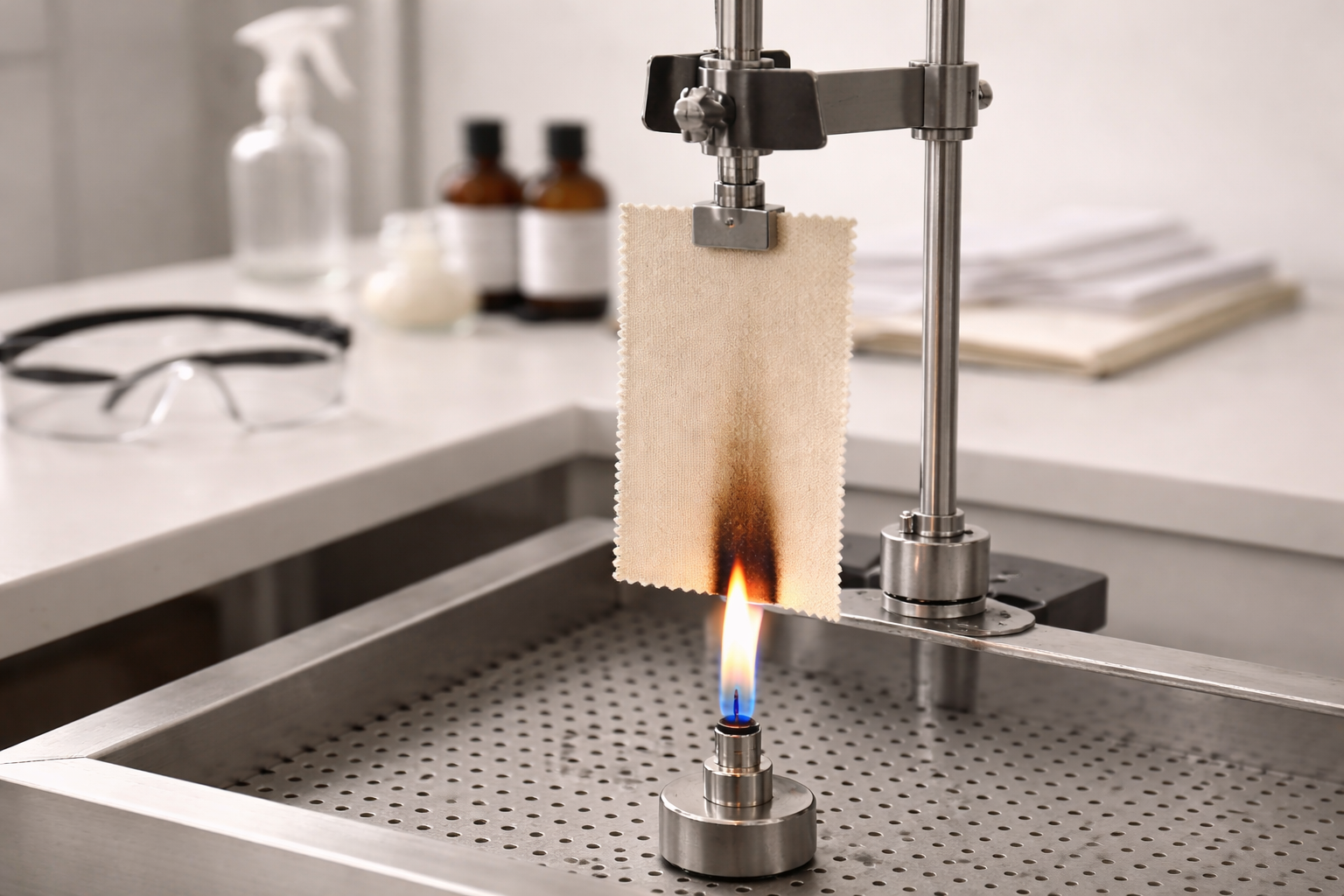
The flammability test (formally called the "char length" test) measures how far a flame travels up a vertically suspended fabric sample. To pass, the average char length must not exceed 7 inches, and no single specimen can have a char length exceeding 10 inches.
In practice, this means using fabric that either has inherent flame-resistant properties or has been treated with flame-retardant chemicals. Most modern children's sleepwear brands avoid this path because flame-retardant treatments raise health and marketing concerns. Parents increasingly don't want chemical treatments on garments their children sleep in. As a result, many brands choose GOTS organic cotton for children's sleepwear and pursue the snug-fit exemption instead of flame-retardant treatments. For seasonal collections, the holiday pajama compliance pathway often relies on snug-fit construction instead of flame-retardant chemical treatment. Some brands also explore essential-oil treated fabrics for kids as part of allergy-conscious and sensitive-skin sleepwear collections.
Some synthetic fabrics (particularly certain polyester blends) can pass flammability testing without chemical treatment, but this limits your fabric choices significantly. Many emerging brands are now exploring alternatives to mass-licensed sleepwear manufacturers that offer lower MOQs, transparent sourcing, and stronger sustainability standards. For brands evaluating bamboo-based fabrics, understanding bamboo rayon certifications can help clarify which standards apply to the finished fabric, processing facility, and source material.
Path 2: The Tight-Fitting Exemption (What Most Brands Use)
The far more common approach is to design sleepwear that qualifies as "tight-fitting." The CPSC allows this exemption because snug-fitting garments are less likely to contact an ignition source and less likely to sustain a flame if they do. The snug-fit pathway for sleep sacks is especially common because the garment is already designed with a close, body-skimming silhouette.
To qualify, your garments must meet specific maximum dimensional measurements at every size point. These measurements cover chest width, waist width, seat width, sleeve width, and other key points. The garment must fit closely to the body without excess fabric.
The dimensional requirements are precise and size-specific. For example, a size 2T pajama top has different maximum width measurements than a size 6 top. Your pattern maker and manufacturer need to be working from the official CPSC dimension tables, not estimating.
Key rules for tight-fitting sleepwear: the garment cannot have any part that exceeds the specified maximum dimensions. Elastic at wrists, ankles, and waist helps maintain the snug fit. Decorative elements (ruffles, bows, loose ribbons) can be problematic because they add fabric that extends beyond the body.
Testing Requirements
Regardless of which path you take, you need third-party testing from a CPSC-accepted laboratory. Here's what that involves.
Initial testing is required before you sell your first unit. You submit fabric samples and finished garments to an accredited lab. For tight-fitting sleepwear, the lab verifies that your garment dimensions comply with the required measurements. For flame-resistant sleepwear, they perform the vertical flame test on fabric specimens.
Testing frequency is production-based. You need to test each production unit (essentially each production batch). If your manufacturer produces 500 units of a specific style and colorway, that batch needs a test report. If you then produce another 500 units in a different colorway, that's a separate test.
Cost typically runs $200 to $500 per test, depending on the lab and the number of specimens required. Testing turnaround is usually 2 to 3 weeks.
Accredited labs are listed on the CPSC website. Your manufacturer should have established relationships with testing labs and be able to coordinate testing on your behalf.
Labeling Requirements
Children's sleepwear has specific labeling requirements that go beyond standard garment labels.
Every children's sleepwear garment must have a permanent label that includes: fiber content, country of origin, manufacturer or importer identification (your RN or company name), care instructions, and a tracking label that allows the garment to be traced to specific production units.
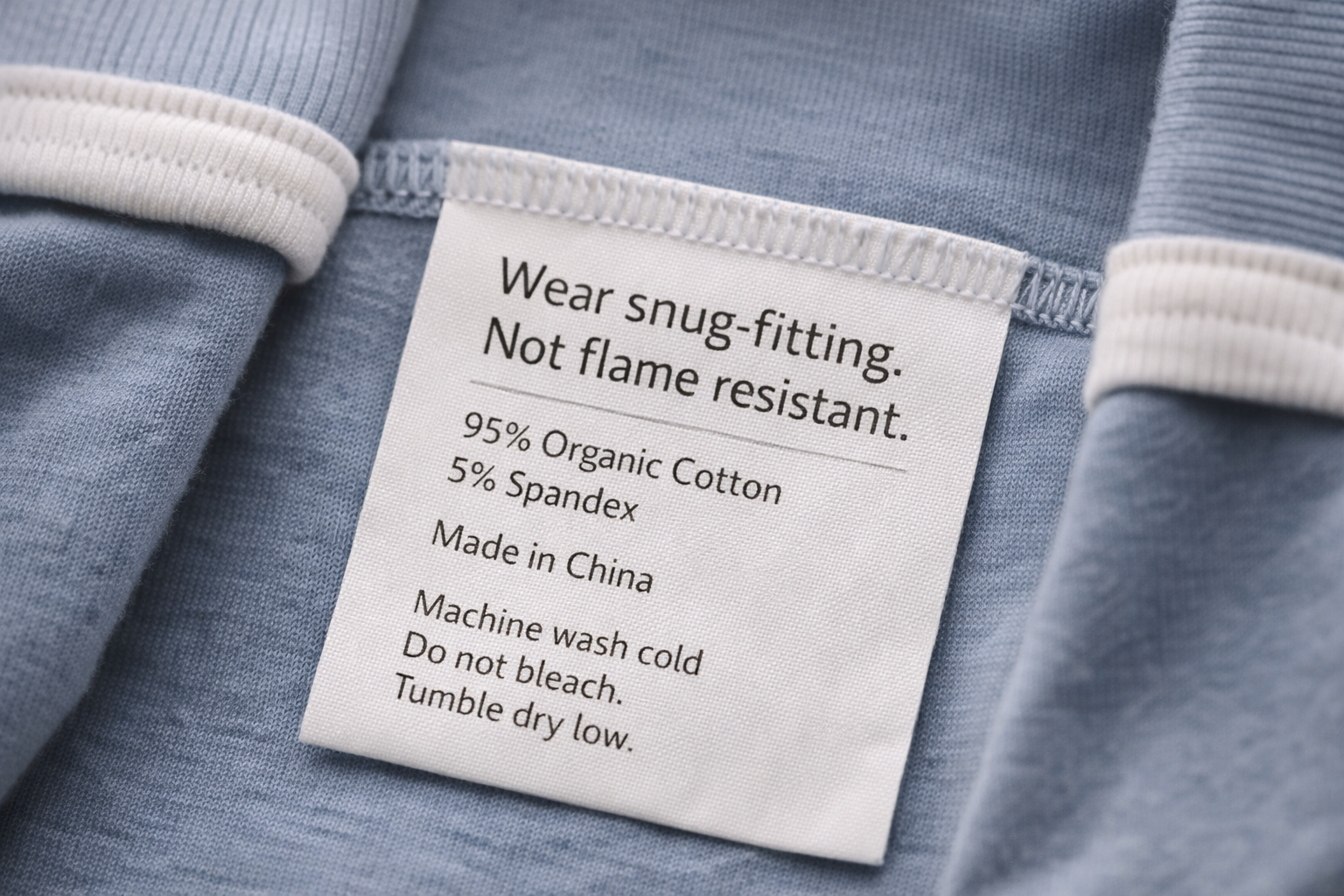
Tight-fitting sleepwear must also include a hang tag and a permanent label with the statement: "Wear snug-fitting. Not flame resistant." This exact language is required by the CPSC. It must appear on the garment itself (not just the packaging) and on any hang tag.
The tracking label requirement under CPSIA Section 103 is particularly important. Each garment must be permanently marked with enough information to identify the manufacturer, production date or batch, and any other production details needed for traceability in case of a recall.
The General Certificate of Conformity (GCC)
Before you sell or import children's sleepwear, you must issue a Children's Product Certificate (CPC) — sometimes called a General Certificate of Conformity. This is a document (not a physical label) that certifies your product has been tested and meets all applicable safety standards.
Your CPC must include: identification of the product, citation of each CPSC rule the product was tested against, identification of the CPSC-accepted testing lab, the date and place of testing, contact information for the person maintaining test records, and the date and place of manufacture.
You keep the CPC on file and provide it to retailers and customs on request. Many retailers and marketplaces will ask for your CPC before they'll carry your product.
Common Compliance Mistakes We See
After years of manufacturing children's sleepwear, these are the errors we see most often from new brands.
Mistake 1: Assuming all baby clothes are sleepwear. The CPSC defines "sleepwear" as garments sized 9 months through 14 that are designed or marketed for sleeping. If your product is marketed as "daywear" or "playwear" and fits loosely, it may not need to meet sleepwear flammability standards — but it still needs to meet general children's product requirements. However, if it looks like sleepwear (pajama sets, nightgowns, sleepers), the CPSC will treat it as sleepwear regardless of what you call it. Don't try to dodge the rules by labeling pajamas as "loungewear."
Mistake 2: Testing fabric but not finished garments for tight-fit. The dimensional compliance of tight-fitting sleepwear is measured on the finished garment, not the pattern. Sewing tolerance, shrinkage after washing, and elastic recovery all affect final dimensions. Test the actual finished product.
Mistake 3: Forgetting that each colorway needs testing. Different dyes and treatments can affect flammability. A white pajama set and a navy pajama set in the same fabric and style still require separate testing.
Mistake 4: Not planning for testing lead time. Testing takes 2 to 3 weeks. If you don't build this into your production timeline, you'll either delay your launch or be tempted to ship untested product (which is illegal).
Mistake 5: Using a manufacturer who isn't familiar with CPSIA. This is a dealbreaker. If your manufacturer can't walk you through the compliance process, guide your pattern dimensions, and coordinate testing, you're working with the wrong partner. Our guide to baby clothing compliance covers what to look for in a manufacturer before you commit.
Canadian and Australian Requirements
If you're selling into Canada, children's sleepwear must comply with the Canada Consumer Product Safety Act and the Children's Sleepwear Regulations (SOR/2016-169). The requirements are similar to U.S. standards — garments must either meet flammability testing or be "snug-fitting" — but the specific dimensional requirements differ. Don't assume U.S. compliance automatically satisfies Canadian rules.
For Australia, the relevant standard is AS/NZS 1249, which has its own testing and labeling requirements. Australian standards include a fire hazard classification system (Category 1 through 3) based on fabric type and garment design.
If you're selling internationally, your manufacturer should be able to coordinate testing for all applicable markets simultaneously.
How to Work With Your Manufacturer on Compliance
The compliance process works best when it's integrated into your manufacturing workflow from the beginning, not treated as an afterthought.
Here's what that looks like in practice: during the design phase, your manufacturer reviews your patterns against CPSC dimensional requirements and flags any areas that might fall outside tight-fitting specifications. During sampling, the sample garments are measured against the compliance tables before you approve for production. Before production starts, your manufacturer coordinates third-party testing with an accredited lab. During production, garment dimensions are spot-checked to ensure consistency. After production, your CPC is issued based on the test results.
At our facility, this is built into our standard process for every children's sleepwear order. We don't ship product that hasn't been tested, and we don't let brands skip steps that will create problems down the road.
Compliance Checklist for Your Sleepwear Brand
Use this as a quick reference as you move through the process:
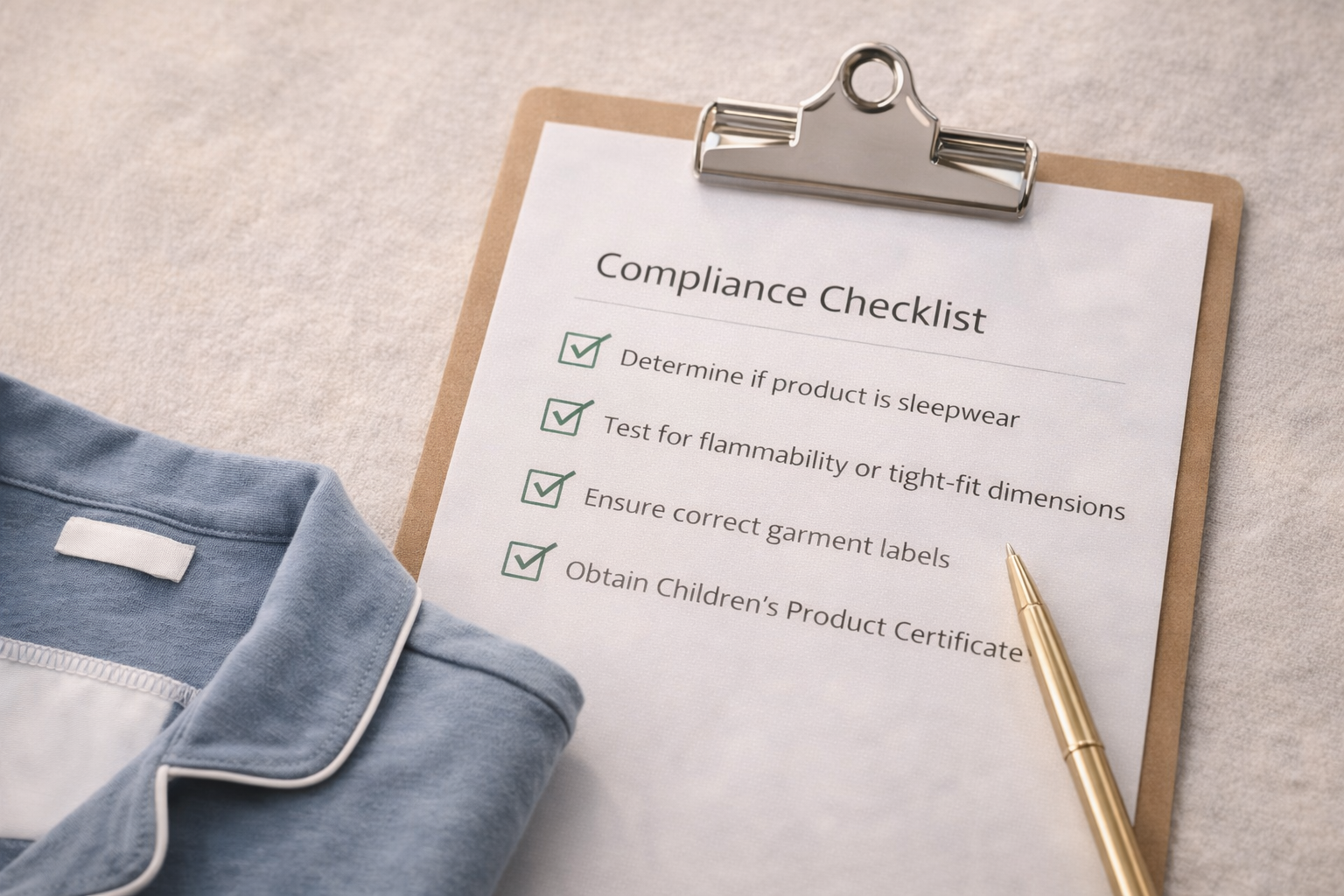
Before design: determine whether your product meets the CPSC definition of children's sleepwear. Decide whether you're pursuing tight-fitting exemption or flammability testing. Source fabric that's appropriate for your chosen compliance path.
During development: ensure patterns meet CPSC dimensional requirements for tight-fitting sleepwear. Include all required label content in your tech pack. Plan your testing timeline and budget.
Before production: submit samples to a CPSC-accepted lab. Receive passing test results. Prepare your Children's Product Certificate.
Before selling: verify CPC is on file and accessible. Confirm all garment labels include required text including "Wear snug-fitting. Not flame resistant." Ensure tracking labels are in place.
Baby pajamas safety regulations compliance — what's required
Baby pajamas safety regulations compliance is governed in the United States by the CPSIA (Consumer Product Safety Improvement Act), which sets specific rules for any garment marketed for sleep in sizes 9 months through 14 years. The two compliance paths are open-flame burn testing (16 CFR 1610) or qualification as snug-fitting under specific dimensional tolerances. Beyond CPSIA, baby pajamas must also meet the broader Consumer Product Safety Commission requirements for children's apparel: tracking labels, third-party testing, and Children's Product Certificates. Tobimax has been producing CPSIA-compliant baby and children's sleepwear since 1988, with test reports on file from CPSC-accepted independent labs for every fabric, dye, and construction we ship.
Get a quote for compliant children's sleepwear manufacturing
We specialize in CPSIA-compliant children's sleepwear manufacturing, including bamboo rayon, organic cotton, and custom fabric programs. We guide every brand through the compliance process from pattern development through final testing.