
MOQ and FOB Meaning in Garments: Simple Guide for Apparel Brands
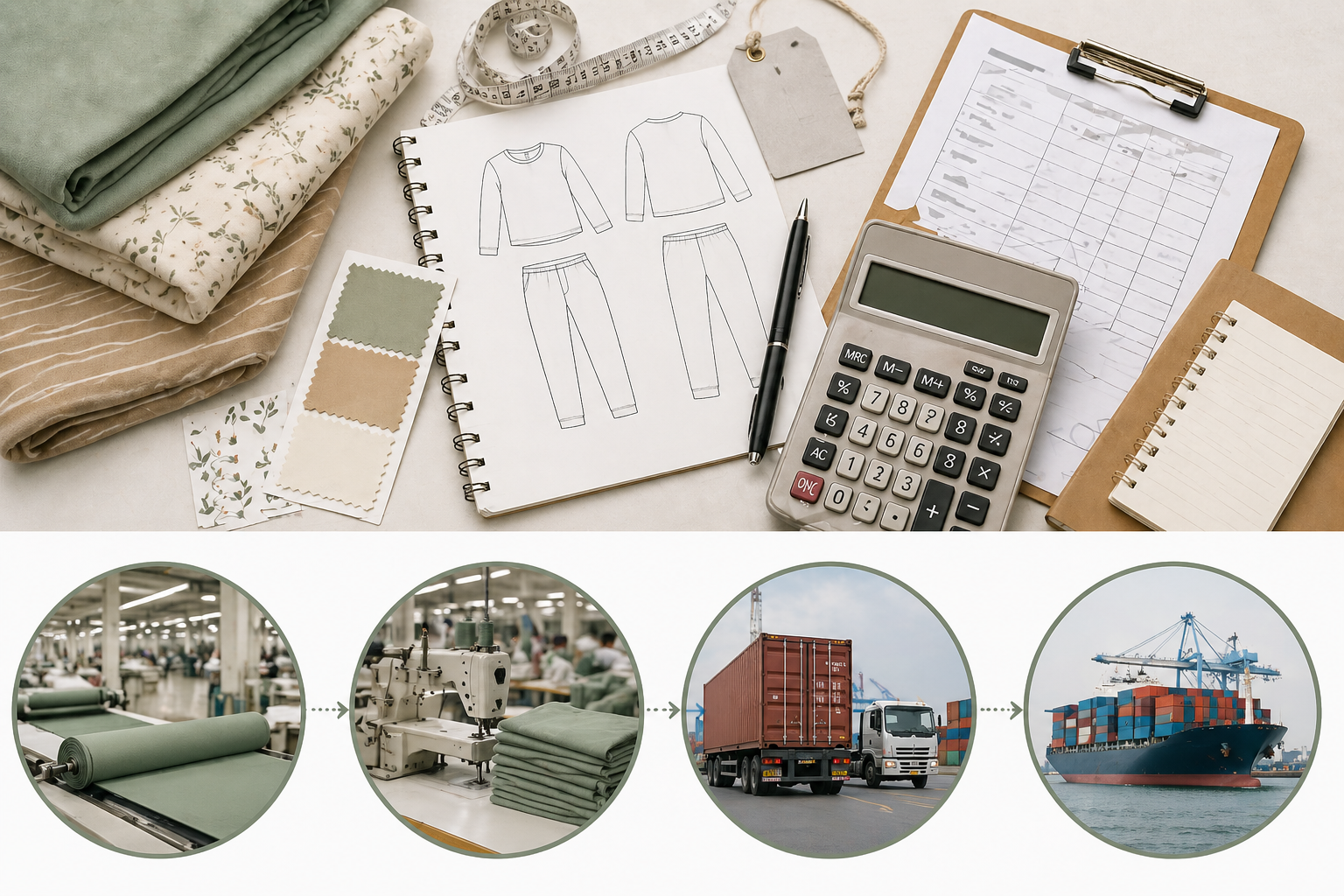
If you're working with a garment manufacturer, you’ll quickly encounter terms like MOQ and FOB. These are standard in the apparel industry, but they’re often unclear to first-time founders.
Here’s what they actually mean and how they affect your costs.
What Does MOQ Mean in Garments?
MOQ stands for Minimum Order Quantity. It’s the smallest number of units a manufacturer is willing to produce per style, color, or order.
For example, if a factory has an MOQ of 500 units, you cannot order 100 units of a design. You must meet or exceed that minimum.
MOQ exists because factories need to cover setup costs, material sourcing, and production efficiency. Smaller orders are less efficient and more expensive to produce.
Typical MOQ ranges:
Small factories: 100 to 300 units
Mid-size factories: 300 to 1,000 units
Large factories: 1,000+ units
Lower MOQ usually comes with a higher per-unit cost.
What Does FOB Mean in Garments?
FOB stands for Free On Board. It refers to a shipping arrangement where the manufacturer is responsible for producing the goods and delivering them to the port of origin.
Once the goods are loaded onto the shipping vessel, responsibility transfers to the buyer.
In simple terms:
The factory covers production and local transport
The buyer covers international shipping, duties, and delivery
FOB vs EXW (Quick Comparison)
Another common term is EXW (Ex Works).
FOB: Factory delivers goods to port, handles export clearance
EXW: Buyer handles everything from factory pickup onward
Most apparel brands prefer FOB because it simplifies logistics.
FOB full form in the garment industry
FOB full form: Free On Board. In garment sourcing it means the factory delivers the finished goods, cleared and loaded at the named port, and the buyer takes over cost and risk from there.
FOB stands for Free On Board. It's an Incoterm (International Commercial Term) used in garment manufacturing contracts to define the point at which cost and risk transfer from the factory to the buyer. The FOB full form is identical across industries (Free On Board is the maritime shipping standard), but in garment manufacturing it specifically refers to the factory's quote covering fabric, trims, cut-make-trim, packing, and delivery to the named loading port. Once goods cross the rail of the vessel at that port, responsibility shifts to the buyer.
FOB factory meaning vs FOB port
The phrase "FOB factory" is informal shorthand. Strictly speaking, FOB always names a port of loading (FOB Shanghai, FOB Hai Phong, FOB Keelung, etc.). When a supplier quotes "FOB factory," they usually mean EXW (Ex Works), where the buyer arranges all inland transport from the factory door to the port. The cost difference between FOB and EXW can be material on large orders. Always confirm in writing which the supplier intends before signing the purchase order. At Tobimax, our FOB quotes name the actual port of loading, so there's no ambiguity in the contract.
FOB in the garment industry, how it differs from CIF and DDP
FOB is the most common pricing term in garment manufacturing because it gives both sides a clean handoff at the origin port. CIF (Cost, Insurance, Freight) extends the seller's responsibility through ocean freight to the destination port, including marine insurance. DDP (Delivered Duty Paid) extends it all the way to the buyer's door, including destination duties and customs clearance. Most experienced apparel buyers prefer FOB because they want control over the international freight arrangement (often through their own freight forwarder) and because FOB quotes are directly comparable across factories in different countries.
One more term worth knowing alongside FOB: what CMT means. It's the labor-only portion of production. FOB quotes bundle CMT together with fabric, trims, and logistics into one price, while a CMT-only quote covers just the labor.
Why MOQ and FOB Matter
These two terms directly impact your pricing and planning:
MOQ determines how much inventory you need to commit to
FOB determines which costs are included in your factory price
Understanding both helps you avoid unexpected costs and negotiate more effectively with manufacturers.
Ready to start your first production run?
Understanding MOQ and FOB is just the beginning. If you're planning a private label sleepwear or apparel line, working with the right manufacturing partner makes all the difference.
We help brands navigate fabric sourcing, production, compliance, and scaling from small runs to full production.