
What Is GSM in Fabric, and What GSM Should Sleepwear Be?
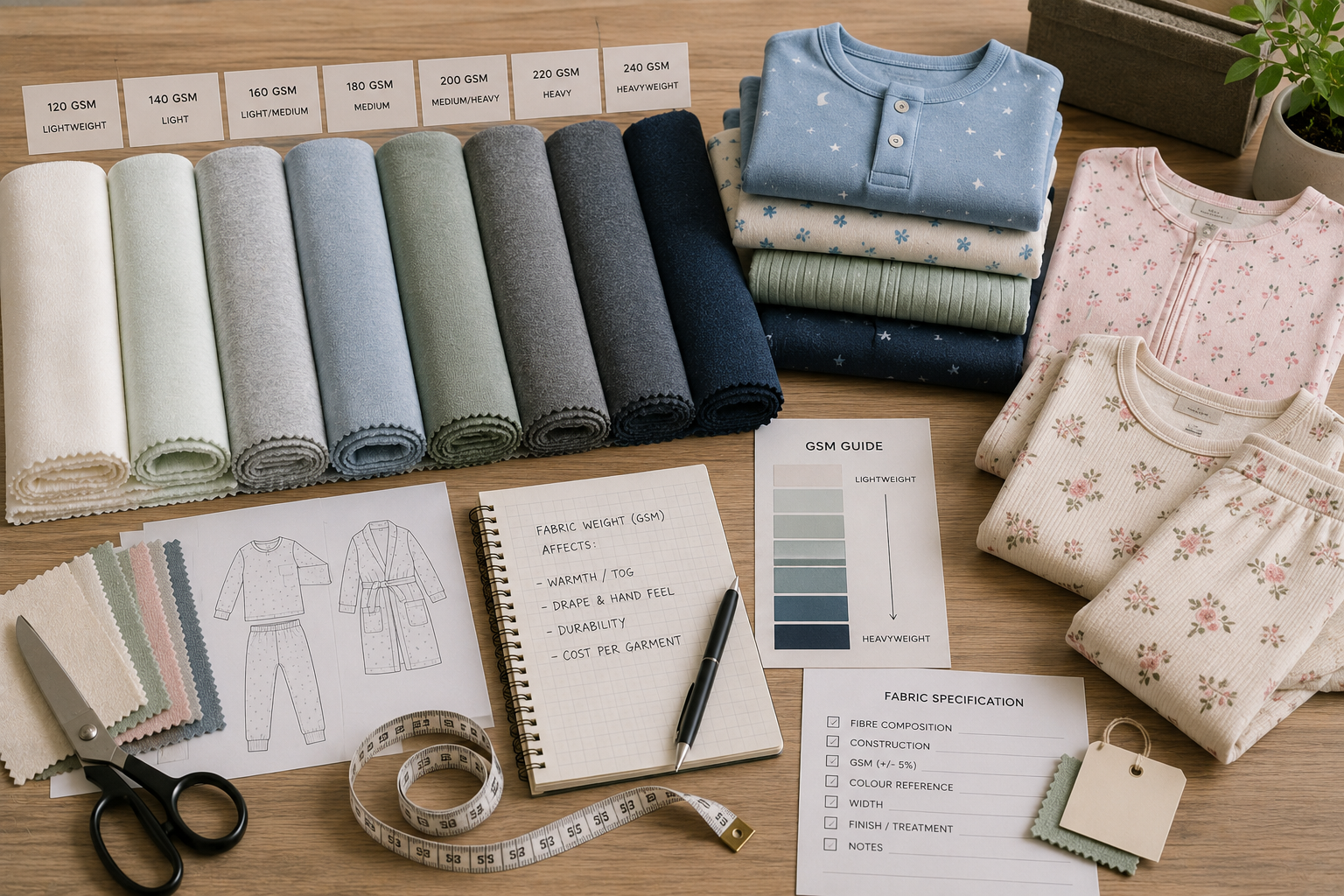
What GSM means
GSM stands for grams per square metre. It is the weight of a fabric measured by how many grams a one-metre by one-metre piece weighs. GSM is the most useful single number for understanding how a fabric will feel, drape, and wear.
A 120 GSM fabric is light, sheer, summer-weight. A 240 GSM fabric is dense, warm, winter-weight. Same fibre, very different garment.
GSM is also called fabric weight, areal density, or m²/g (older spec sheets). The number is the same in all three notations.
Why GSM matters more than fibre alone
A 100% cotton fabric at 120 GSM and a 100% cotton fabric at 240 GSM are both cotton, but they make different garments. The 120 GSM cotton is appropriate for a summer t-shirt. The 240 GSM cotton is appropriate for a sweatshirt. For sleepwear specifically, GSM determines: - TOG (thermal overall grade) of the finished garment - Drape and silhouette behaviour - Wash and wear durability - Cost per garment (heavier fabric = more yarn = higher price)
Two manufacturers can quote the same fibre at very different GSMs. Without specifying GSM in your tech pack, you can receive samples that feel completely different from what you expected.
| Sleepwear product | Recommended GSM range | Why |
|---|---|---|
| Lightweight summer pajama (knit) | 120 to 160 | Cool, breathable, drapes well |
| Standard year-round pajama (knit) | 160 to 200 | Balanced weight, soft hand feel |
| Winter pajama (knit) | 200 to 240 | Warmer feel, more substantial |
| Winter pajama (woven flannel) | 180 to 240 | Brushed surface for warmth |
| Sleep sack lightweight (knit) | 140 to 180 | Single-layer, summer use |
| Sleep sack standard (knit + lining) | 180 to 220 | Two-layer construction for warmth |
| Robe / loungewear | 220 to 320 | Substantial drape, warmth |
| Loungewear sweatshirt | 280 to 380 | Heavyweight knit |
GSM by fabric type for sleepwear
Cotton interlock. 180 to 220 GSM is the default sweet spot. Below 160 starts to feel thin; above 240 starts to feel like activewear.
Cotton ribbed knit. 160 to 200 GSM. Ribbed structure adds visual weight without adding yarn density. Bamboo viscose knit. 140 to 180 GSM. Bamboo's drape lets it run lighter than cotton at the same finished feel.
Modal-cotton blend. 160 to 200 GSM. Common at 60/40 modal/cotton in this range.
Tencel lyocell. 130 to 180 GSM. Tencel's strength lets it run lighter while still feeling substantial.
Cotton-polyester blend (uniforms, basics). 180 to 220 GSM. The polyester adds wash durability at this weight.
Brushed flannel (woven). 180 to 240 GSM. The brushing lifts surface fibres, adding warmth without adding GSM.
How to specify GSM in your tech pack

In the bill of materials section of your tech pack, fabric should be specified with at minimum:
- Fibre composition (e.g., 95% organic cotton 5% elastane)
- Construction (e.g., interlock, jersey, ribbed knit)
- GSM with tolerance (e.g., 180 GSM, +/- 5%)
- Colour reference (Pantone code)
- Width (typical 150 to 180 cm tubular, or 110 to 160 cm open-width)
The tolerance on GSM matters. A fabric specified at 180 GSM but delivered at 200 GSM is technically "out of spec" if the tolerance is +/- 5%, even though the difference doesn't change function in most cases. Mills typically agree to +/- 5% as standard.
Common GSM mistakes
Over-specifying weight. A founder who has worn premium athleisure may want 220 GSM cotton for pajamas. The result is a pajama that's too heavy for sleeping. Sleepwear sits closer to 180 GSM than to athleisure weight.
Under-specifying weight for winter. A 160 GSM cotton in a Christmas pajama set feels thin. Specify 200 GSM minimum for winter-positioned products.
Mixing GSM across the size run. A pajama set with 180 GSM body fabric and 120 GSM lighter accent panels can look uneven and shrink unevenly in wash. Match GSMs within a single garment.
FAQ
What does GSM mean in fabric?
GSM means grams per square metre. It is the weight of a one-metre by one-metre piece of fabric in grams. A 120 GSM fabric is light and summer-weight; a 240 GSM fabric is dense and winter-weight.
What GSM should pajamas be?
For knit pajamas, 160 to 200 GSM is the standard sweet spot for year-round wear. Summer-weight pajamas can run as light as 120 GSM. Winter-weight pajamas can run up to 240 GSM in knits or brushed flannel.
Is higher GSM always better quality?
No. Higher GSM means heavier and warmer, not better. A 220 GSM bamboo viscose can feel less premium than a 160 GSM Tencel lyocell because the fibre and finish matter as much as the weight. Match GSM to use case, not to "more is better."
What GSM is best for sleep sacks?
For single-layer summer sleep sacks, 140 to 180 GSM. For two-layer winter sleep sacks (knit body with cotton or fleece lining), 180 to 220 GSM body fabric.
How is GSM measured by the mill?
The mill cuts a precise 10 cm by 10 cm sample, weighs it on a calibrated scale, and multiplies by 100 to get the GSM. Standard tolerance is +/- 5% from the specified GSM.