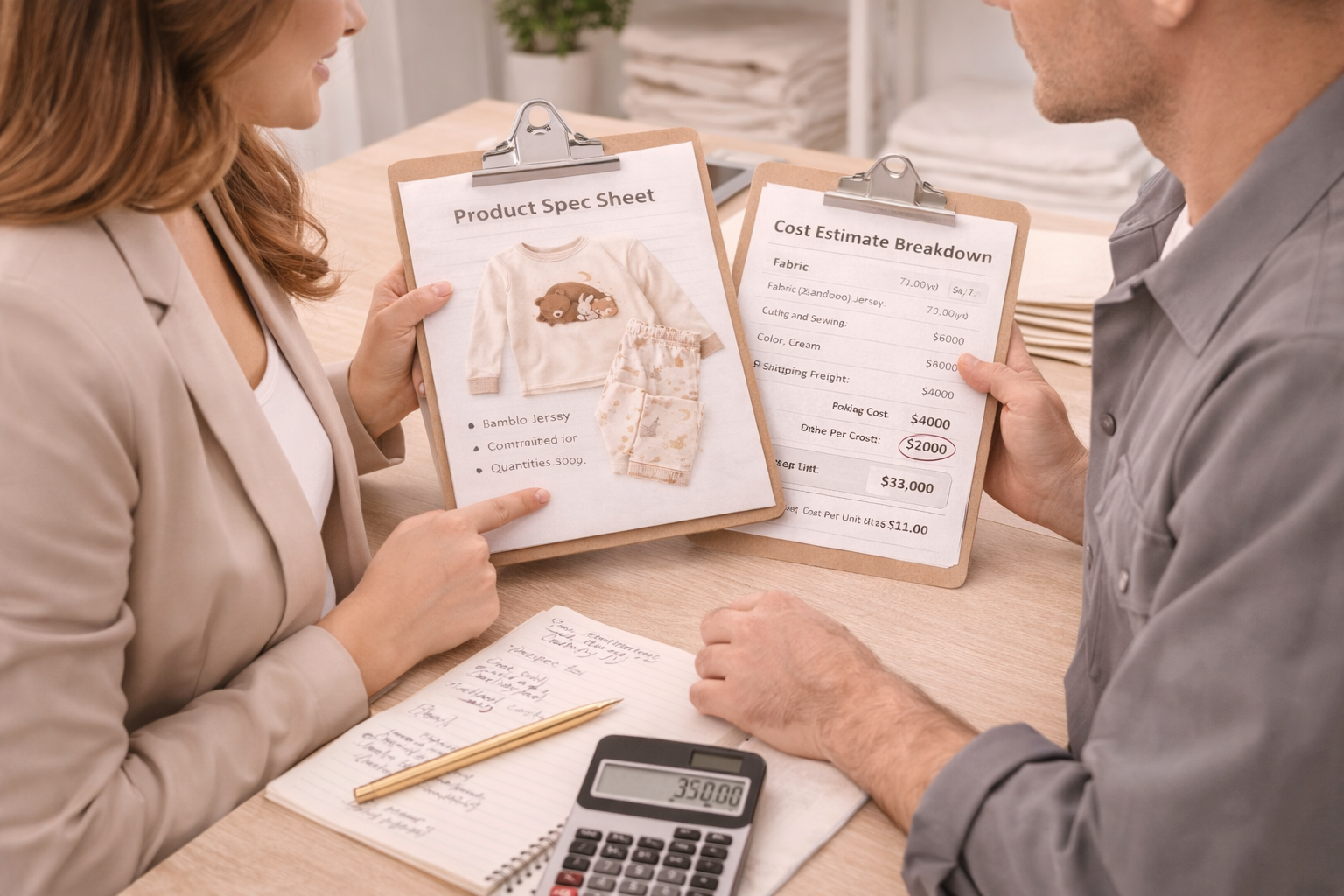
What It Costs to Manufacture Sleepwear (2026 Breakdown)
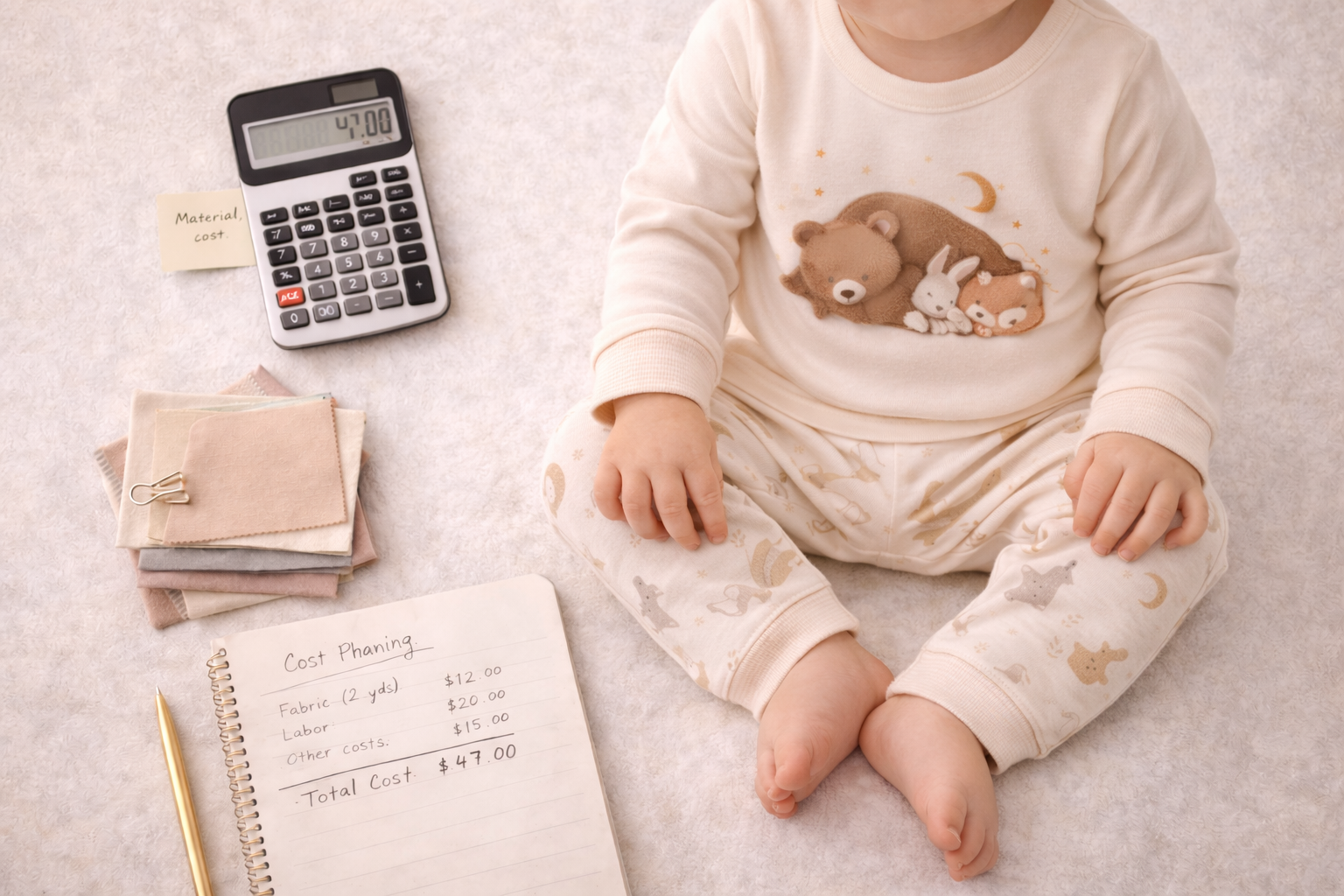
If you've ever Googled "sleepwear manufacturing cost," you probably got vague answers and a lot of "contact us for a quote" buttons. We think that's backwards. Founders deserve to understand their cost structure before they pick up the phone.
This article lays out the real numbers. We'll walk through every component that goes into the cost of manufacturing a children's pajama set, from raw fabric to landed product in your warehouse. The specific numbers will vary based on your fabric, complexity, and volume — but the structure and proportions are consistent across the industry.
The Components of Sleepwear Manufacturing Cost
Every sleepwear garment has the same basic cost components, regardless of whether you're producing 500 units or 50,000. Let's break them down using a real-world example: a children's two-piece bamboo rayon/spandex pajama set, produced overseas and shipped to North America.
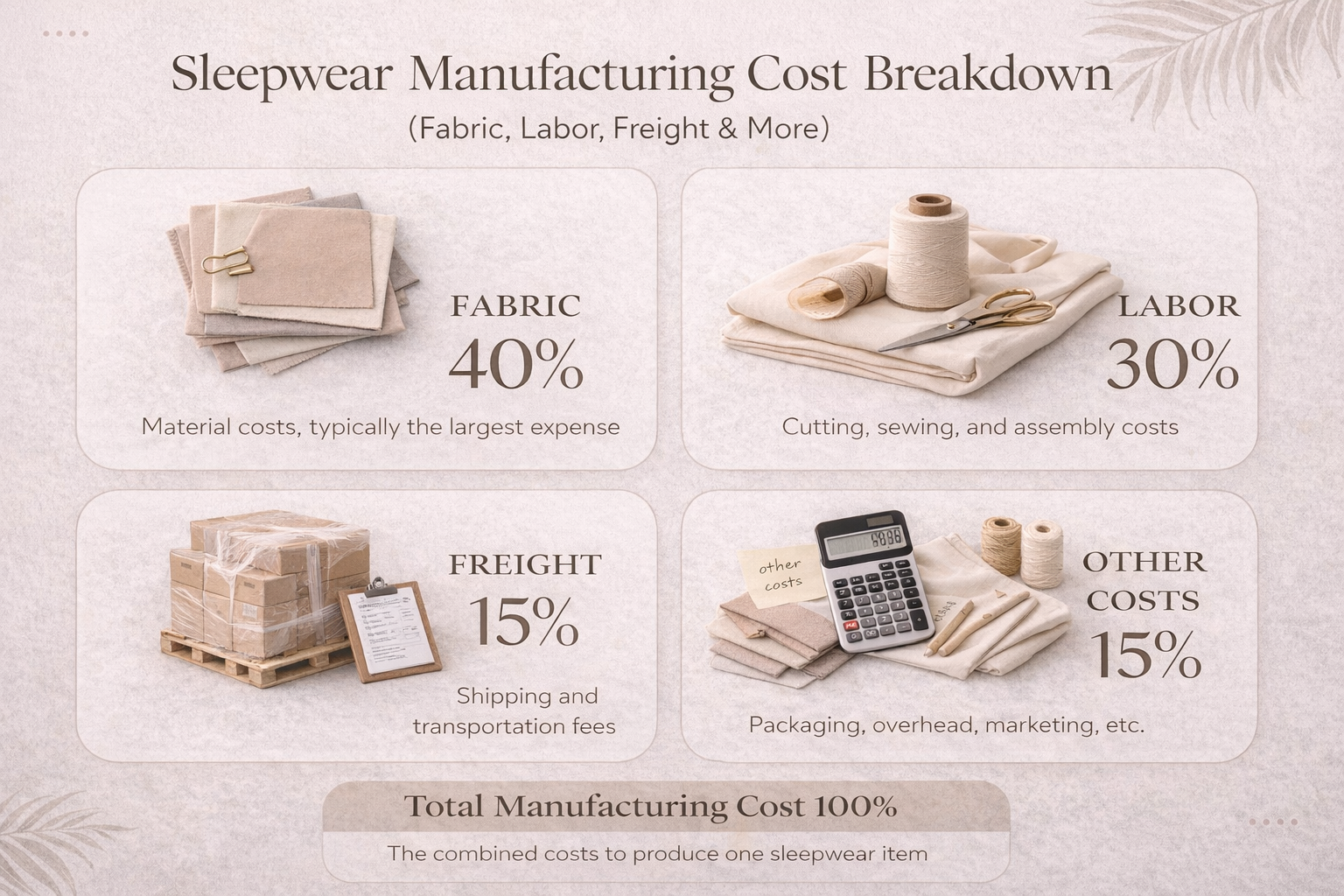
Fabric is almost always the largest single cost component, typically representing 40 to 50 percent of your total manufacturing cost. For a bamboo rayon/spandex blend (95/5), fabric cost runs approximately $4 to $7 per yard, depending on the supplier, weight, and finish. A children's pajama set (top and bottom) uses roughly 0.8 to 1.2 yards of fabric per unit, depending on the size range. That puts your fabric cost at approximately $3.50 to $7.00 per unit. Solid colors are generally cheaper than printed fabric. Reactive prints (which are standard for quality sleepwear) add $0.50 to $1.50 per yard over the solid fabric price.
Cut, Make, and Trim ("CMT pricing") is the labor and production cost. This covers cutting the fabric, sewing the garment, attaching labels and tags, pressing, folding, and packing. For a straightforward two-piece pajama set manufactured overseas, CMT typically runs $2.00 to $4.50 per unit. More complex designs (additional pockets, contrast piping, appliqué details, zippers) push this higher. Simpler designs (basic elastic waist, standard neckline) keep it lower.
Trims and accessories include everything that's not the main fabric: elastic for waistband, wrists, and ankles, woven labels (brand and care), printed hang tags, size labels, and poly bags for individual packaging. For a standard pajama set, trims run roughly $0.40 to $1.00 per unit. If you're adding custom branded packaging (tissue paper, branded bags, gift boxes), this can jump to $1.50 to $3.00.
Pattern making and grading is a one-time cost per style, not per unit. Developing your pattern from a tech pack or sample, then grading it across your full size range (say, 2T through size 10) typically costs $300 to $800 per style. This is amortized across your production run — on a 500-unit run, it adds $0.60 to $1.60 per unit; on a 5,000-unit run, it's negligible.
Sampling runs $50 to $150 per sample garment, and you should expect 2 to 3 rounds of samples before production. Budget $200 to $500 per style for the sampling process. Like pattern making, this is a one-time cost that decreases on a per-unit basis as your order volume increases.
Beyond the Factory: Costs That Surprise First-Time Brands
The factory gate price (fabric + CMT + trims) is only part of your total landed cost. Here's what else you need to budget for. If you're comparing local and overseas production, our landed cost breakdown explains how freight, duties, brokerage fees, and production costs combine to determine your true cost per unit.
Compliance testing for children's sleepwear (CPSIA/flammability) costs $200 to $500 per colorway. If you're launching 4 colorways, that's $800 to $2,000. This is non-negotiable if you're selling children's sleepwear in the U.S. For emerging brands entering the category, a children's sleepwear cost roadmap usually includes compliance testing, fit sampling, packaging, and retail preparation in addition to production costs. Our guide on how to start a pajama business covers the full process, from manufacturer selection and product development to launch planning and scaling your brand.
Freight and shipping varies dramatically based on method and destination. Sea freight from Asia to North America for a small order (2 to 5 CBM) might cost $500 to $1,500 total, or roughly $0.30 to $1.00 per unit on a 2,000-unit order. Air freight is 3 to 5 times more expensive but gets your product to you in days instead of weeks.
Customs duties are a significant cost that many first-time brands underestimate. For knitted synthetic garments (like bamboo rayon pajamas) imported from China to the U.S., expect duties of roughly 15 to 32 percent depending on the exact HS code classification. For Canada, the MFN rate for similar garments is approximately 18 percent. Duty is calculated on the declared value of the goods, so on a $7.00 per-unit factory cost, you might be paying $1.05 to $2.25 per unit in duties alone.
Customs brokerage and clearance fees add another $100 to $300 per shipment, or you can work with a broker who charges per entry.
Putting It All Together: Real Cost Example
Here's a realistic total landed cost for a children's bamboo rayon/spandex two-piece pajama set, manufactured in China, landed in the U.S.
Fabric cost per unit: $5.00. CMT per unit: $3.00. Trims per unit: $0.60. Pattern and sampling (amortized over 2,000 units): $0.40. Compliance testing (amortized over 2,000 units across 4 colors): $0.50. Freight per unit: $0.60. Duties (estimated 20 percent on FOB value): $1.70. Brokerage per unit: $0.10.
Total landed cost per unit: approximately $11.90.
At a wholesale price of $16 to $18, that gives you a 25 to 34 percent wholesale margin. At a retail price of $34 to $38, your DTC gross margin is 65 to 69 percent.
These are representative numbers, not exact quotes. Your actual costs will vary based on fabric choice, order volume, production complexity, and sourcing decisions. But this gives you a realistic framework to build your financial model.
How Volume Affects Your Cost
Manufacturing has significant economies of scale. Here's how the same pajama set might cost at different volumes.
At 500 units (our minimum), your per-unit cost is highest because fixed costs (patterns, sampling, testing) are spread across fewer units, and your fabric cost per yard is higher at lower volumes. Expect total landed cost of $13 to $16 per unit. For founders launching their first collection, our guide on finding a small-batch clothing manufacturer as a startup explains how to evaluate low-MOQ partners and plan a realistic first production run.
At 2,000 units, you're in the sweet spot where fabric pricing improves, fixed costs become negligible per unit, and CMT rates may drop slightly. Total landed cost of $10 to $13 per unit.
At 10,000 units and above, you unlock the best fabric pricing, your manufacturer may offer volume discounts on CMT, and your freight cost per unit drops significantly. Total landed cost of $8 to $11 per unit.
The jump from 500 to 2,000 units is where you see the most dramatic cost improvement — typically a 15 to 25 percent reduction in per-unit cost.
Hidden Costs to Plan For
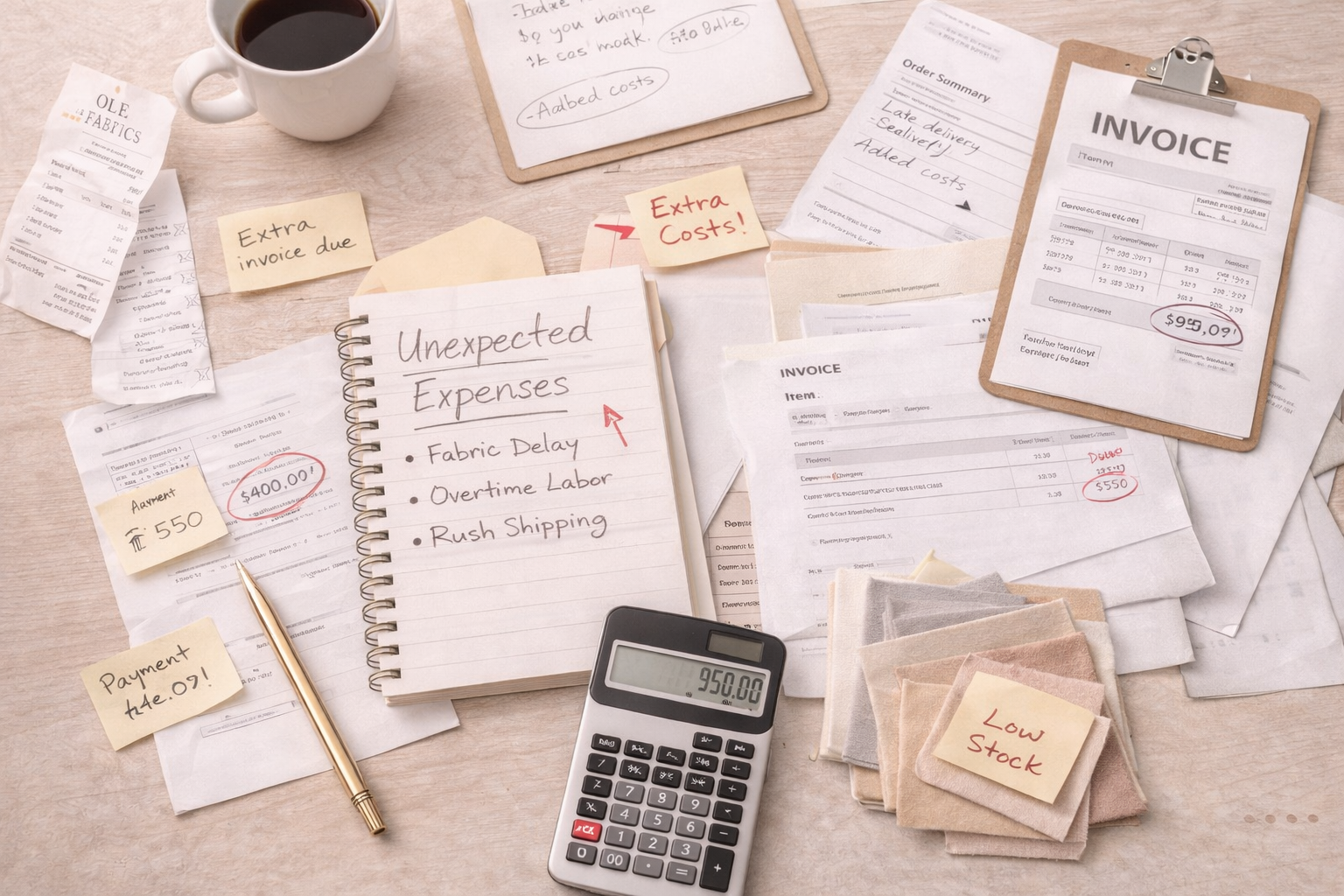
Beyond the per-unit cost, budget for these items that catch new brands off guard.
Overruns and underruns. Standard manufacturing tolerance is plus or minus 5 percent on your order quantity. If you order 1,000 units, you might receive 950 to 1,050. You'll be invoiced for the actual quantity produced.
Defects and seconds. Even with good quality control, expect 1 to 3 percent of units to have minor defects. Budget accordingly or negotiate a defect allowance with your manufacturer.
Photography and content creation. You need product photography before you can sell. Budget $500 to $2,000 for a professional product shoot of your initial collection.
Returns and exchanges. If you're selling DTC, plan for a 5 to 15 percent return rate, which affects your effective cost per sale.
How to Lower Your Manufacturing Costs
After working with dozens of sleepwear brands, here are the most effective cost levers.
Simplify your designs. Every additional seam, trim, or detail adds cost. The most profitable sleepwear brands have clean, simple designs that look premium through fabric quality, not construction complexity.
Consolidate your colorways. Instead of 8 colors at 250 units each, consider 4 colors at 500 units each. Same total volume, but better pricing on fabric and more efficient production runs.
Use a mixed sourcing strategy for prints and solids. Printed fabric and solid fabric often have different optimal suppliers. Your manufacturer may be able to source solids from one mill and prints from another, optimizing cost on each.
Order consistently. Manufacturers give better pricing to repeat clients with predictable order patterns. Your second and third orders will almost always be cheaper than your first.
Plan ahead to avoid air freight. Sea freight is a fraction of the cost of air. Build enough lead time into your calendar to ship by sea.
Getting an Accurate Quote
When you reach out to a sleepwear manufacturer for a quote, provide as much detail as possible: your fabric preference (or send a swatch), your size range, your target order quantity, the number of styles and colorways, any special construction details, and your target delivery date.
The more specific your inquiry, the more accurate and competitive your quote will be. Vague requests ("how much do pajamas cost to make?") get vague answers.