
How to Start a Children's Sleepwear Brand in 2026
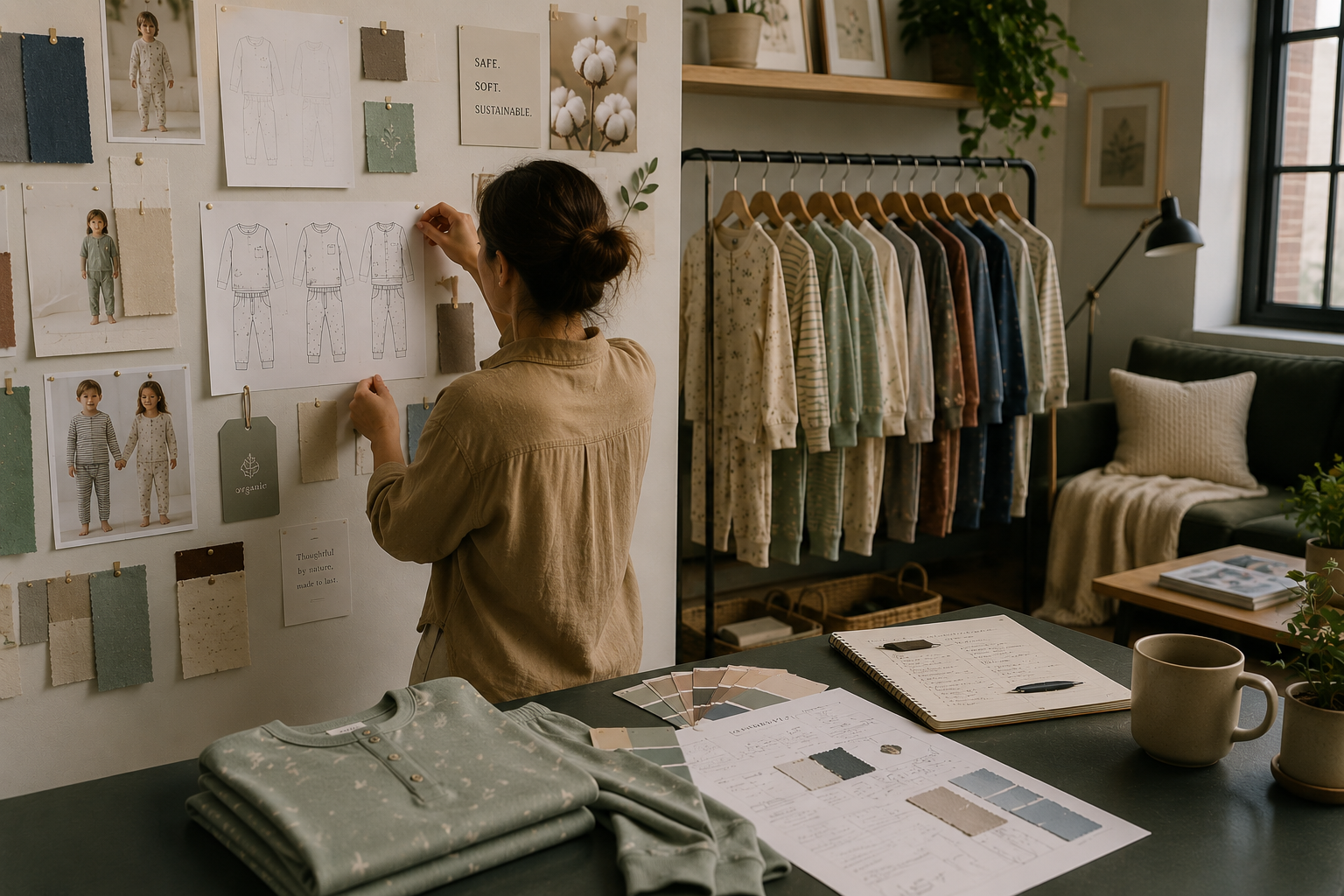
Why children's sleepwear is its own thing
Adult sleepwear is fashion. Children's sleepwear is regulated apparel. The difference matters from day one.
In the U.S., any garment marketed as infant or children's sleepwear (sizes 9 months through size 14) must meet CPSIA flammability rules. There's no startup carve-out, no exemption for small brands, no "we're DTC so it's different." Lab testing, certificates of conformity, and tracking labels are required from your first production run.
This article is the operational roadmap for a founder building a children's sleepwear brand from zero. Twelve months from concept to retail-ready.
Months 1 to 2. Concept, audience, and price point
Three decisions that lock in everything downstream:
Audience. Boutique parents (premium, organic, story-driven) buy a different garment than mass-market parents (price-sensitive, big retailer). You can't serve both with the same product line.
Price point. Founder-led children's sleepwear brands typically land at one of three points:
- Premium ($28 to $48 per piece retail) — GOTS organic cotton, snug-fit, chemical-free positioning
- Mid-tier ($16 to $26) — OEKO-TEX cotton blend, snug-fit, soft positioning
- Mass ($8 to $15) — conventional cotton or cotton-poly, can be FR or snug-fit
Compliance pathway. Snug-fit or FR-treated. (See the snug-fit vs FR comparison article on this blog for the full breakdown.)
The single biggest mistake at this stage is locking in retail price before pricing the actual cost. A premium GOTS organic snug-fit two-piece pajama set at MOQ 400 has a real FOB unit cost of $9.50 to $13.00, which sets a retail floor. Don't skip the cost math.
Months 3 to 4. Tech pack and manufacturer selection
A tech pack is the technical specification document the factory needs to quote, sample, and produce. Minimum contents:
- Flat sketches (front, back, side) with construction call-outs
- Bill of materials (fabric, trims, threads)
- Measurement spec sheet at each size break with tolerances
- Construction notes (seam type, stitch density, finishing)
- Trim spec (labels, hangtags, polybag)
- Print or embroidery artwork at correct DPI
- Care label requirements (fibre content, country of origin, RN number, care symbols)
Manufacturer selection criteria for a new children's sleepwear brand:
1. CPSIA experience. Has the factory shipped CPSIA-tested products before? Do they have lab relationships? Tobimax has produced children’s sleepwear since 1988, with CPSIA test reports on file for every run we ship.
2. MOQ at your scale. A factory whose minimum is 5,000 units per style won't fit a 400-unit launch. Tobimax's MOQ is 400 units per style and colour.
3. Sustainability certs that match your story. GOTS, OEKO-TEX, bluesign should appear on the actual fabric lot certificate, not just the mill's brochure.
4. Communication cadence. Ask how often the production team updates customers. Weekly is standard for a small program.
Month 5. Sampling
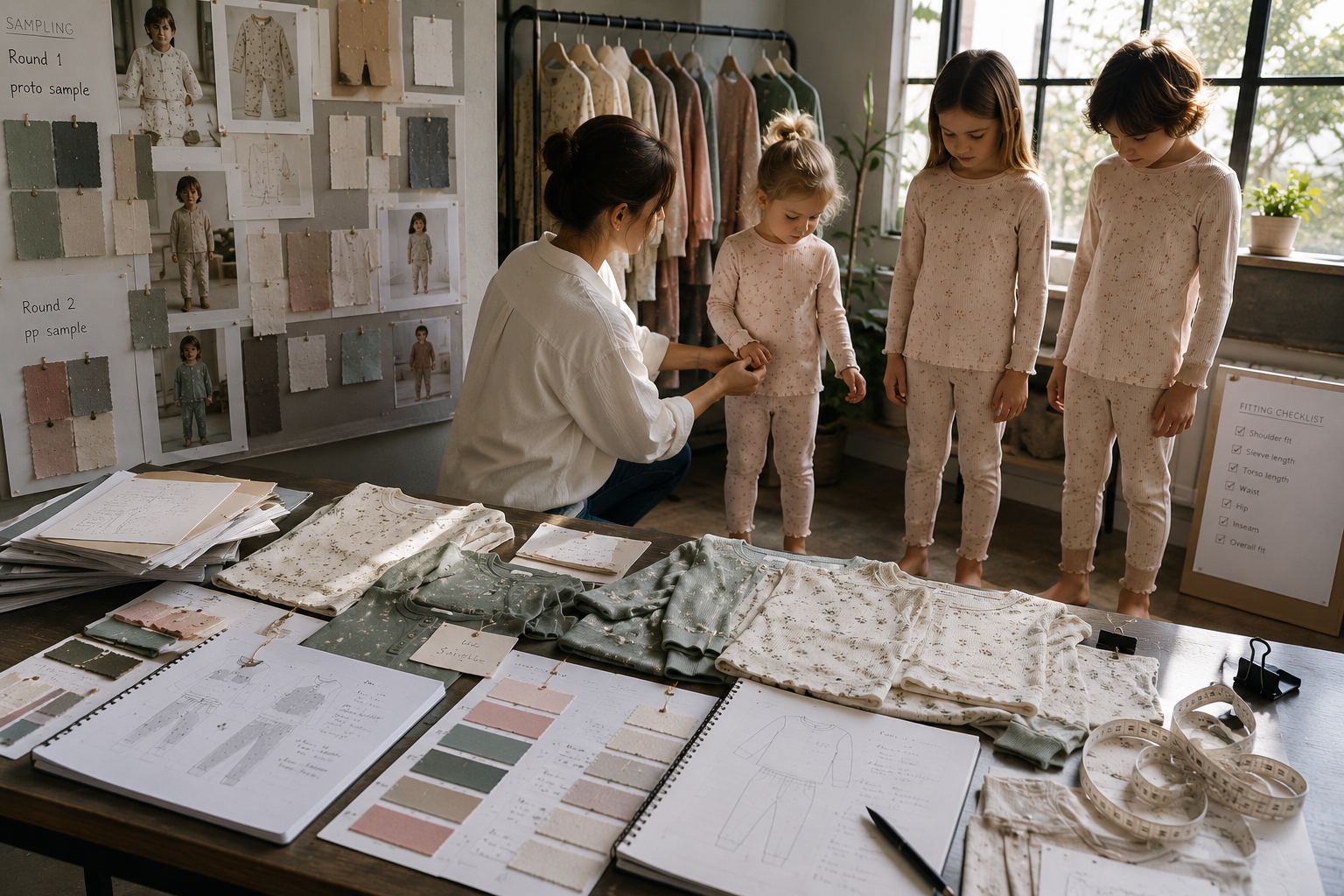
Two rounds of samples is the realistic minimum:
Round 1 (proto sample). Construction, fit silhouette, fabric. 2 to 4 weeks.
Round 2 (PP sample, pre-production). Final fabric, final trims, final dimensions. 2 to 3 weeks. For snug-fit pajamas, fit verification at each size break is critical. You'll want to fit at least three sizes (smallest, mid-range, largest) on real children to confirm the snug-fit construction holds.
For snug-fit pajamas, fit verification at each size break is critical. You'll want to fit at least three sizes (smallest, mid-range, largest) on real children to confirm the snug-fit construction holds.
Month 6. Lab testing
CPSIA testing per fabric and colourway. CPSC-accepted lab. Standard scope:
- Flammability (16 CFR 1615 or 1616) — dimensional or burn-rate test
- Lead content (16 CFR 1303 if any painted or printed surface)
- Phthalates (CPSIA section 108 if any plastic component)
- Tracking label verification (16 CFR 1130)
Cost typically $400 to $900 per fabric and colour combination.
The general certificate of conformity (GCC) is generated from the test results and travels with every shipment.
Months 7 to 9. Production and finishing
Bulk production lead time at Tobimax for a children's pajama program is 8 to 10 weeks from approved PP sample to FOB. Finishing (hangtags, polybags, retail-ready packing) is included in the production window. AQL Level II inspection is the standard quality bar.
Months 10 to 11. Logistics and retail prep
FOB shipment from origin port (Hai Phong, Keelung, or Shenzhen depending on factory) to U.S. arrival is typically 18 to 28 days. Customs clearance, port handling, and last-mile to your warehouse adds 5 to 10 days.
If selling DTC, plan inventory at warehouse 4 weeks before launch date for QC, photography, and Amazon FBA prep if applicable.
If selling wholesale, line sheets and pre-orders should be open by month 8 so retail buyers have product committed before bulk hits the warehouse.
Month 12. Launch
A first-run children's sleepwear program at premium positioning needs to sell through 60 to 70% of inventory in the first 90 days to fund the second order. Marketing cost is typically $4 to $9 per unit acquired in the first run.
The second run is when the unit economics actually work. The first run pays for the moulds.
Honest budget for a 400-unit launch program
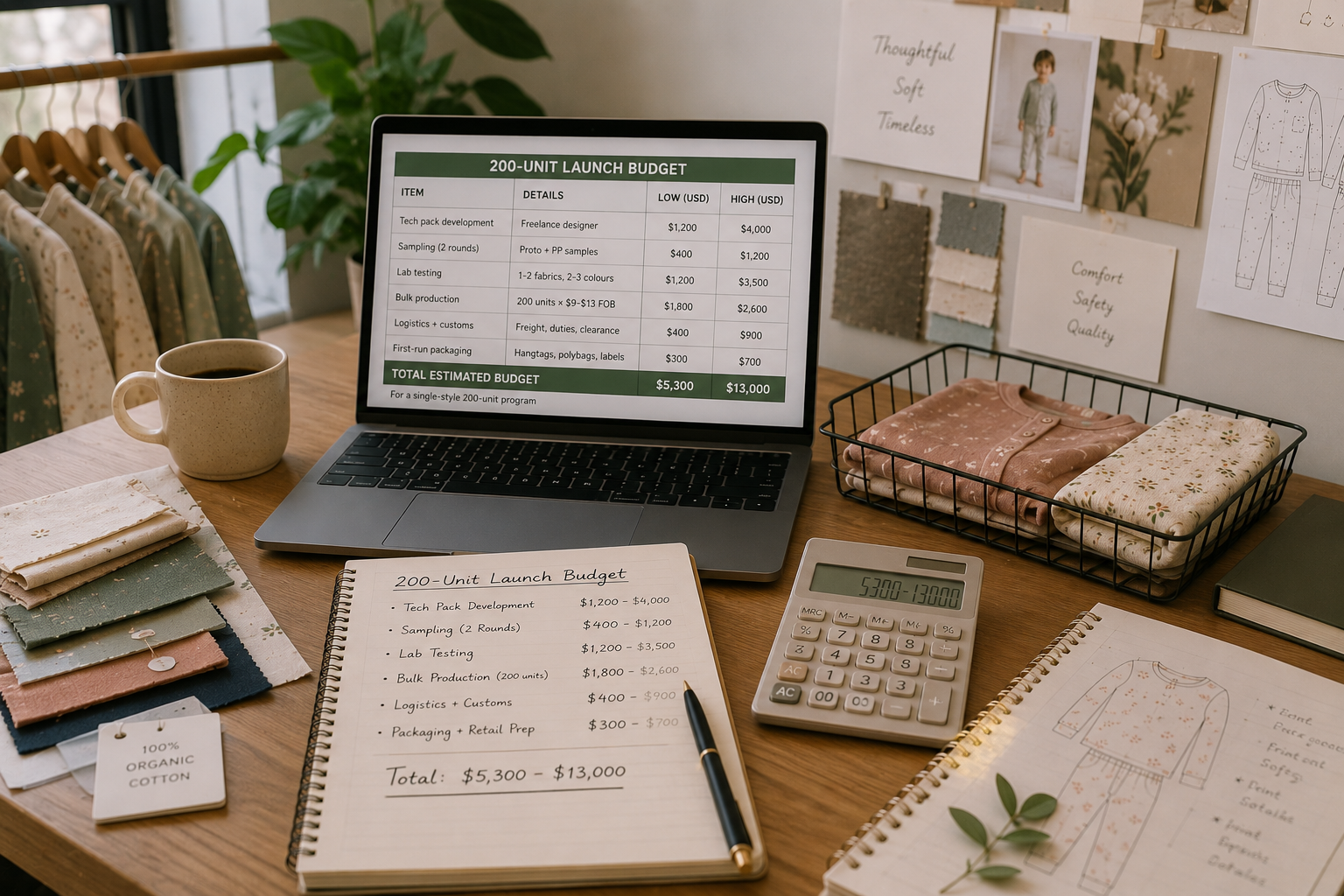
- Tech pack development (freelance designer): $1,200 to $4,000
- Sampling (2 rounds): $400 to $1,200
- Lab testing (1 to 2 fabrics, 2 to 3 colours): $1,200 to $3,500
- Bulk production (200 units × $9 to $13 FOB): $1,800 to $2,600
- Logistics + customs: $400 to $900
- First-run packaging + retail prep: $300 to $700
- Total: roughly $5,300 to $13,000 for a single-style 200-unit program
What kills new children's sleepwear brands
Three patterns from working with founders since 1988:
1. Underestimating lab testing cost and timeline. Plan it from month 1. Don't discover it at month 6.
2. Buying fabric before pattern grading is final. Fabric minimums are typically higher than your first run. Grading changes that affect yardage will burn through cushion fast.
3. Picking too many styles for the first run. One style with three colourways at 400 each is far more launchable than three styles at 400 each. Concentrate inventory on the proven concept.
FAQ
What's the minimum to start a children's sleepwear brand?
Tobimax's MOQ for children's sleepwear is 400 units per style and colourway. The total cash to launch a single-style 400-unit program is typically $5,300 to $13,000 including tech pack, sampling, lab testing, production, and logistics.
Do I need CPSIA testing if I sell only DTC?
Yes. CPSIA applies to any children's sleepwear sold in the U.S., regardless of channel. DTC, Amazon, wholesale all require the same lab testing and general certificate of conformity.
How long from concept to first retail-ready inventory?
Realistic range is 9 to 12 months for a first-time founder. The compressible windows are concept and design (Month 1 to 4) and post-production logistics. Sampling, lab testing, and bulk production have hard minimums that don't compress.
What's a typical FOB unit cost for snug-fit children's pajamas?
At MOQ 400, a two-piece GOTS organic cotton snug-fit pajama set typically lands at $9.50 to $13.00 FOB. Lower fabric specs and larger run sizes pull this down meaningfully.
Should I start with one style or a small range?
One style with three colourways is the lowest-risk launch. It concentrates inventory on the proven concept, simplifies tech pack work, reduces lab testing cost, and makes inventory management easier in the first 90 days.