
How to Vet an Ethical Sleepwear Manufacturer

Why vetting your manufacturer is the most important decision you will make
The manufacturer you choose decides more about your brand than your logo does. They control whether your fabric is safe against a child's skin, whether your "ethical" claim survives a retail buyer's scrutiny, and whether your launch ships on time or becomes a recall. Vetting is not a formality you rush through to start production. It is the work that protects everything you build on top of it. The good news is that a serious manufacturer makes vetting easy, because they have nothing to hide and the documents are already on file.
This is the checklist we would use if we were in your shoes.
Step one, ask for the certifications by name and verify them
Certifications are the fastest signal, but only if you check them rather than trust the logo. Ask for each one by certificate number, not by the badge on the website.
- GOTS (Global Organic Textile Standard). Confirms organic cotton stays organic through processing, including dyes and finishes, and carries social criteria for the workers.
- OEKO-TEX Standard 100. Confirms the finished fabric has been tested free of harmful substances, the thing that matters most for skin contact.
- bluesign. Confirms cleaner, safer chemical and water use in processing.
- WRAP or a recognized social-compliance audit. Speaks to the factory's labor and safety conditions.
A manufacturer who can send the current certificates within a day is one who lives by them. A manufacturer who stalls or sends an expired scan is telling you something.
Step two, look for real evidence of ethical labor, not the word
This is where most "ethical" claims fall apart, because ethical is easy to write and hard to prove. Ask direct questions and expect direct answers.
- How are wages set, and can you show it
- Do you hold third-party social audits, and will you discuss the findings
- Who actually makes the garments, and where
- How long have your factory relationships lasted
A manufacturer who humanizes their own supply chain, the faces behind the fashion, will answer these without flinching. A manufacturer who deflects to "we only work with good factories" has not earned the claim.
Step three, confirm they can actually prove compliance
If you are making children's sleepwear, compliance is not optional and it is the single most common cause of a recall. Ask whether they test the actual production lot (not just the sample) through CPSC-accepted labs, and whether they hold the test reports, the Children's Product Certificate, and tracking-label records on file. Our guides to CPSIA flammability compliance (link to /blog/childrens-sleepwear-flammability-standards-and-cpsia-compliance-everything-your-brand-needs-to-know) and why sleepwear recalls happen (link to /blog/childrens-sleepwear-recalls-causes-and-prevention) cover exactly what to ask for.
Step four, test the MOQ and sampling reality
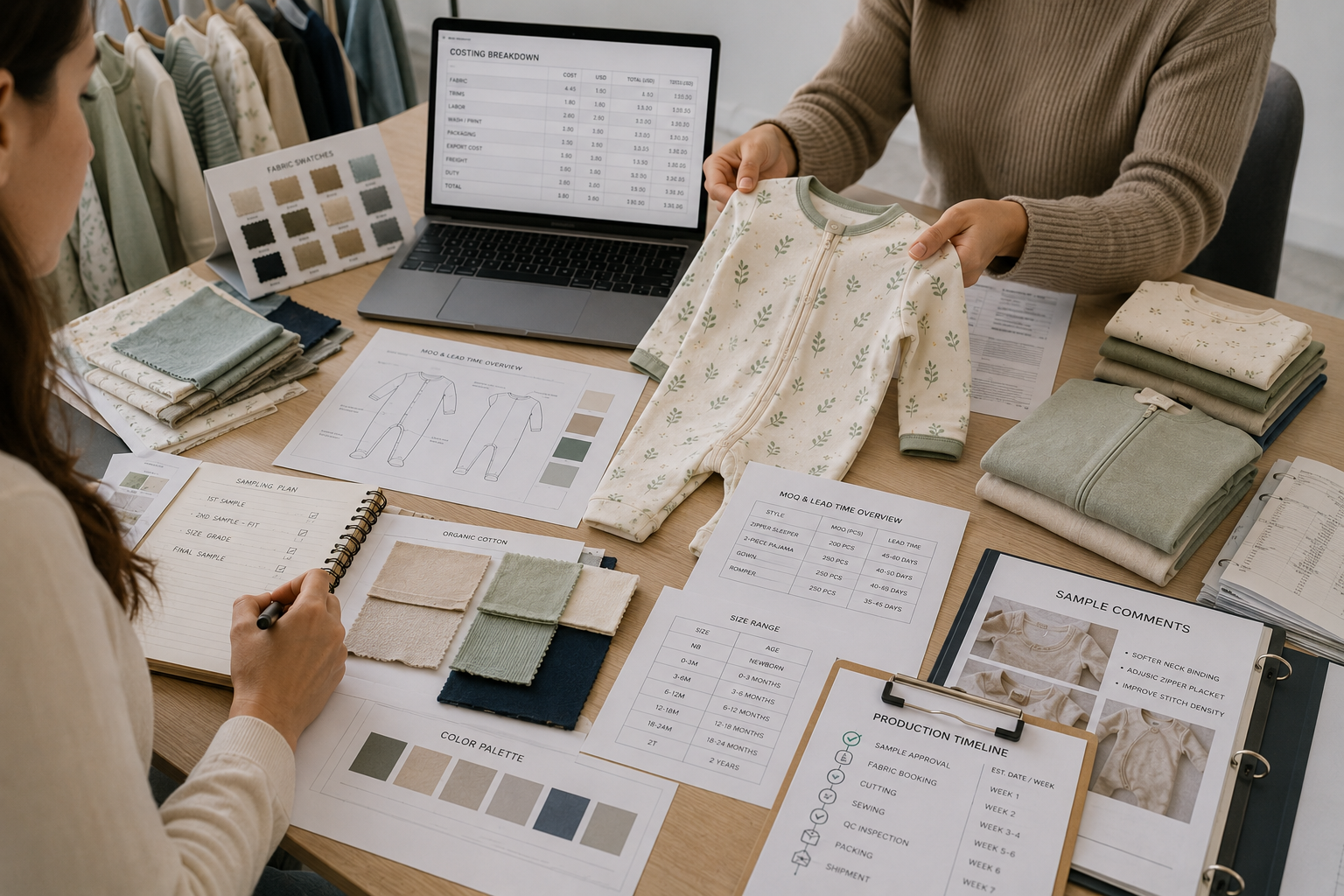
A manufacturer who is right for a growing brand will run a low MOQ and treat a small first order as the start of a relationship. If you're still searching for the right production partner, our guide on finding a small-batch clothing manufacturer as a startup explains where to look, what minimums are realistic, and how to avoid common mistakes.
Confirm the minimum order quantity per style and colourway, the sampling process and its timeline, and how revisions are handled. If the minimums only make sense at tens of thousands of units, they are not built for where you are. Our guide to a low-MOQ sleepwear manufacturer covers what reasonable looks like. If you're vetting a manufacturer, it's also worth understanding the trade-offs between local production and overseas partners, particularly around minimums, lead times, sourcing flexibility, and cost.
Step five, ask about traceability and pricing honesty
Two final tests. First, traceability. Can they tell you where the yarn and the fabric come from, not just where the sewing happens. Second, pricing. Honest pricing is itemized and explainable, you should understand what each line covers. A quote that cannot be broken down is a quote you cannot trust.
The first-call checklist
Run this on your first real conversation.
- Can you send your GOTS, OEKO-TEX, and bluesign certificates by number? Good answer: sent within a day, current dates.
- How do you verify ethical labor and wages? Good answer: third-party audits they will discuss openly.
- Do you test the production lot for CPSIA, not just the sample? Good answer: yes, through CPSC-accepted labs, reports on file.
- What is your MOQ per style and colourway? Good answer: a few hundred units, not tens of thousands.
- Where do your yarn and fabric come from? Good answer: a specific answer, not "various suppliers."
- Can you itemize a quote so I understand each cost? Good answer: yes, line by line.
Red flags to walk away from
- Certificates that are expired, missing, or "available later"
- Vague answers about who makes the garments and under what conditions
- Compliance treated as the buyer's problem rather than part of production
- Minimums that only work at volumes you are years away from
- A quote that cannot be explained line by line
How Tobimax answers the checklist
Tobimax is a family-owned, female-led ethical garment manufacturer, in operation since 1988 across two generations, with factories in Vietnam and China. We are GOTS, OEKO-TEX Standard 100, and bluesign certified, and we send the current certificates on request. We test production lots for CPSIA compliance through CPSC-accepted labs and hold the reports on file. We run from MOQ 400 per style with honest, itemized pricing, and the brands we partner with (Whistle & Flute, Jax & Lennon, LS among them) stayed because we treat them as an extension of the family. If you are vetting partners for your next run, request a quote and we will walk you through every line of the checklist above.
FAQ
How do I vet a sleepwear manufacturer for ethical labor?
Ask for third-party social-compliance audits (such as WRAP) and how wages are set, and expect them to discuss the findings openly. Confirm who makes the garments and where, and how long the factory relationships have lasted. Evidence beats the word "ethical" every time.
What certifications should an ethical sleepwear manufacturer have?
GOTS for organic cotton, OEKO-TEX Standard 100 for tested-clean fabric, bluesign for cleaner processing, and a recognized social-compliance audit such as WRAP. Always ask for them by certificate number and check the dates.
How do I know a manufacturer can handle children's sleepwear compliance?
Ask whether they test the actual production lot (not just the sample) through CPSC-accepted labs, and whether they hold the test reports, Children's Product Certificate, and tracking-label records on file for every run.
What is a reasonable MOQ when vetting a manufacturer?
For a growing brand, a low MOQ of a few hundred units per style and colourway is reasonable. Tobimax runs from MOQ 400 per style. Minimums in the tens of thousands signal a factory built for very large brands.