
Finding a Clothing Manufacturer for Your Canadian Brand

The three real options for a Canadian clothing brand
If you run a Canadian apparel brand and you are choosing where to make your product, you have three honest options, domestic Canadian production, sourcing from China, and sourcing from a treaty partner like Vietnam. Each has a real case and real tradeoffs, and the right answer depends on your margins, your volumes, and the story your brand needs to tell. The goal of this guide is to lay them out plainly so you can choose with your eyes open. If you're sourcing for Canadian brands, understanding how duties, trade agreements, manufacturing capacity, and fabric sourcing affect your landed costs is just as important as comparing factory quotes.
Option one, manufacturing in Canada
Domestic production has a genuine appeal. The supply chain is short, the "made in Canada" story is strong with certain customers, and oversight is easy when the factory is a drive away. For some brands, particularly small premium runs where the origin story carries the price, it is the right call.
The honest limits are cost and capacity. Canadian apparel factories carry higher overhead, the technical-fabric options are narrower, and many brands hit a ceiling on volume as they scale. The result is a higher landed cost that the retail price has to absorb. Domestic works best when your customer is paying specifically for the domestic story, and less well when you are competing on shelf price.
Option two, sourcing from China
China remains the largest apparel supply base in the world, with deep fabric availability and mature factories. For many categories it is still capable and competitive.
The tariff math has changed the calculation for Canadian importers, though. China does not have a free trade agreement with Canada, so most apparel imports face Most Favored Nation duties that can run as high as 18%. That duty lands on every unit and compresses your margin, which is why a growing number of Canadian brands are re-examining whether China is still their best base.
Option three, sourcing from Vietnam (a treaty partner)
Vietnam is now the destination many Canadian brands are shifting toward, and the reason is structural. Vietnam is a member of the CPTPP, the trade agreement Canada is part of, which means apparel that meets the agreement's rules of origin can enter Canada at a 0% duty rate. Against China's MFN duties, that difference flows straight to your gross margin without changing your retail price.
Vietnam has also shed its old "low-cost assembly" reputation. Our full guide to ethical clothing manufacturers in Vietnam covers what that shift looks like in practice. The better factories now offer the transparent, sustainable, and ethical supply chains that Canadian buyers increasingly require, alongside strong technical capability. The one detail to get right is the rule of origin. The CPTPP uses a yarn-forward rule, which means the yarn and fabric generally need to originate within member countries for the duty break to apply. Fabric sourced from outside the agreement can disqualify the 0% rate even when the garment is sewn in Vietnam, so it is worth confirming with your manufacturer which of your fabrics qualify.
How to choose, and the questions that decide it
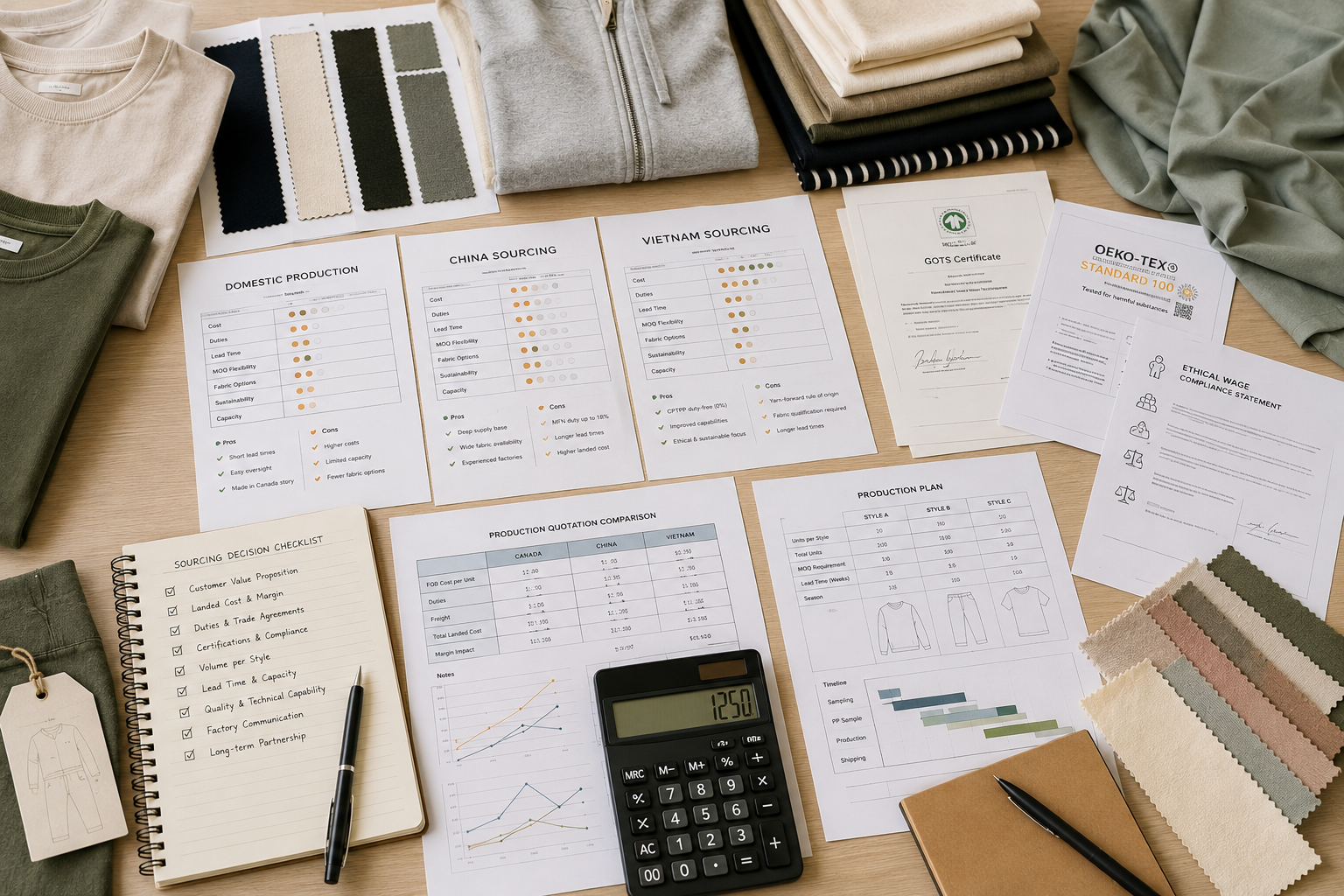
The decision usually comes down to a few honest questions.
- Is my customer paying for a "made in Canada" story? If yes, domestic may justify its cost. If no, overseas usually wins on landed cost.
- What is my per-unit margin tolerance? China's MFN duty compresses margin. Vietnam's CPTPP path can protect it where fabric qualifies.
- Do my retail buyers require ethical and sustainability documentation? Choose a partner who can show GOTS, OEKO-TEX, and ethical-wage evidence, wherever they are based.
- What is my volume per style? Domestic and large China runs suit different volumes than a low-MOQ overseas partner.
Where Tobimax fits for Canadian brands
Tobimax is a family-owned, female-led ethical garment manufacturer, in operation since 1988 and now run across two generations, with factories in Vietnam and China. For Canadian brands, the fit is deliberate. You get an ethical overseas manufacturing base with the certifications retail buyers ask for, GOTS for organic cotton and OEKO-TEX Standard 100 across our fabrics, and the Vietnam capability that the current sourcing shift favours. We work from MOQ 400 per style, with honest pricing and a sampling process designed to protect your launch runway. For the brands we partner with, the relationship matters as much as the run.
FAQ
Where can Canadian brands manufacture clothing?
Canadian brands have three main options, domestic Canadian factories, sourcing from China, and sourcing from a CPTPP treaty partner like Vietnam. Domestic offers a short supply chain and a made-in-Canada story at a higher cost. China offers depth but faces Canadian MFN duties up to 18%. Vietnam can enter Canada at 0% duty where fabric meets CPTPP rules of origin.
Why are Canadian brands moving apparel sourcing to Vietnam?
Because Vietnam is a CPTPP member, qualifying apparel can enter Canada duty-free, while most apparel from China faces MFN duties as high as 18%. That margin difference, plus Vietnam's improved ethical and technical capability, is driving the shift.
Does Tobimax manufacture in Canada?
No. Tobimax manufactures in Vietnam and China and serves Canadian brands as an ethical overseas manufacturing partner. We are not a domestic Canadian factory.
What certifications should a Canadian brand look for in a manufacturer?
Look for GOTS for organic cotton, OEKO-TEX Standard 100 across fabrics, and clear ethical-wage and processing evidence. Retail buyers increasingly require this documentation regardless of where the factory is based.