
UV-Protective Uniforms for Outdoor Crews, Sports Teams, and Event Merch
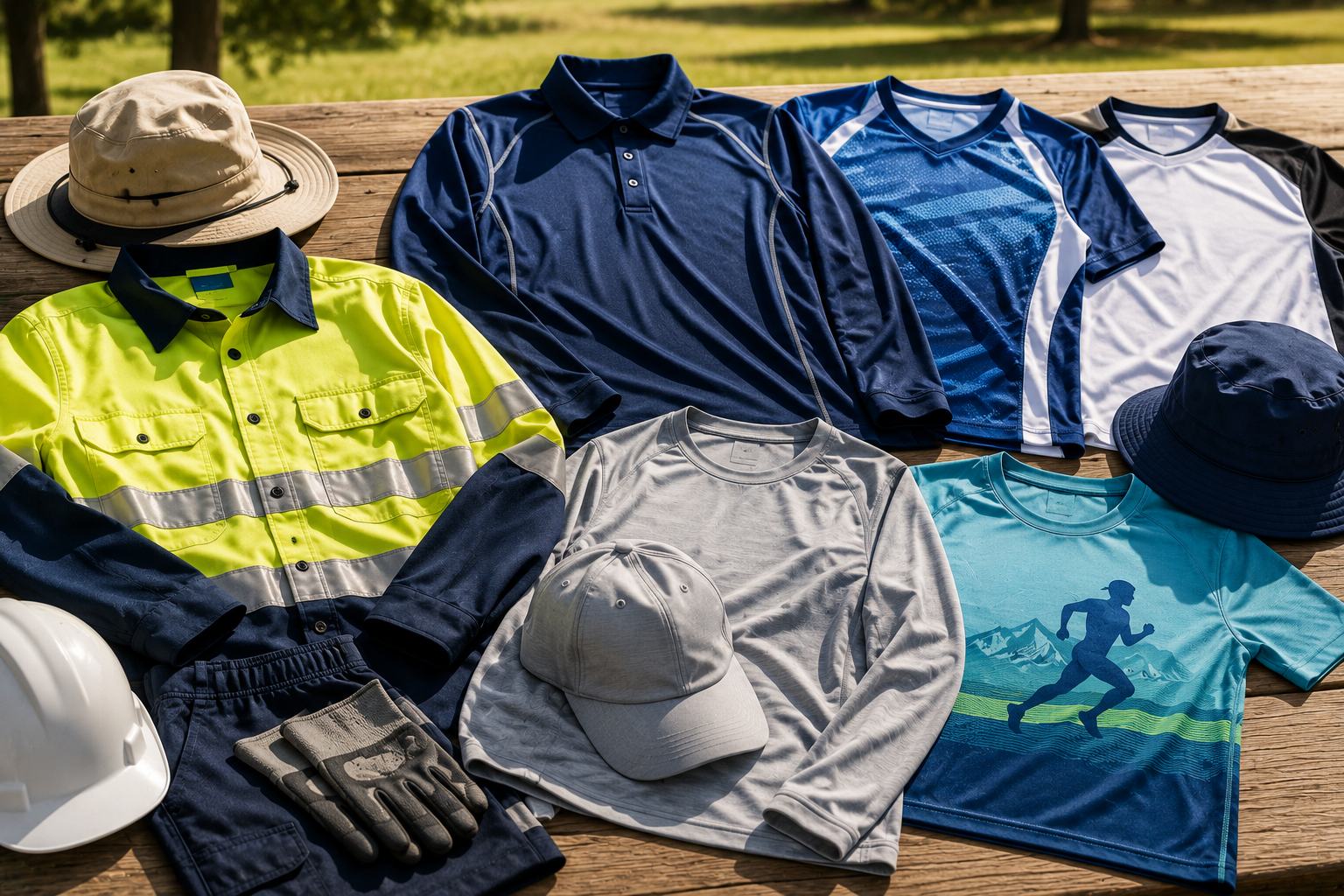
Who's asking for UV-protective uniforms
Three buyer categories driving the inbound inquiries we're seeing in 2026:
Outdoor crew uniforms. Landscaping, construction, agriculture, parks-and-rec, utility crews. OSHA hasn't mandated UV-rated workwear federally, but corporate health-and-safety programmes are adopting UPF 50+ as part of voluntary heat-and-sun-exposure mitigation. The driver is liability, retention, and visible care for outdoor staff.
Sports team uniforms. Outdoor sports at the youth, club, and college level. Soccer, lacrosse, track and field, golf, tennis programmes. UPF-rated team uniforms are increasingly written into equipment-budget line items, especially in Sun Belt and Mountain West conferences.
Marathon and event merch. Race tees that are functional, not just souvenirs. UPF-rated race tees are a differentiating spec for events held in summer or sun-exposed conditions. Premium-entry races and longer-distance events are increasingly choosing UPF tees over basic cotton or virgin polyester, since the participant base is outdoors for hours.
UPF ratings explained (the same scale, but the buyer math is different)
UPF (Ultraviolet Protection Factor) measures the fraction of UV radiation a fabric blocks:
| UPF rating | UV transmission | Classification |
|---|---|---|
| UPF 15 to 24 | 1/15 to 1/24 transmits | Good |
| UPF 25 to 39 | 1/25 to 1/39 transmits | Very Good |
| UPF 50+ | Less than 1/50 transmits (98%+ blocked) | Excellent |
For workwear and athletic use, UPF 50+ is the standard target. The price step between UPF 30 and UPF 50+ is usually modest, and buyers asking the question at all are typically asking for the top spec.
Fabric options for UV-rated uniforms
The decision tree depends on the use case:
For outdoor crew / workwear (durability priority):
Recycled polyester (rPET) treated to UPF 50+ — durable, holds up to repeated industrial laundering
Polyester/cotton blends with UV treatment — balances comfort and durability
For sports team uniforms (performance priority):
Densely woven recycled polyester — moisture-wicking + inherent UPF 50+
Bamboo rayon blends for warm-weather sports — softer hand feel, naturally UV-protective
For marathon and event merch (comfort + brand priority):
Lightweight rPET with UV treatment — keeps the souvenir feel while delivering function
Cotton-rich blends with UV treatment — for events prioritising comfort over performance
How UV-rated uniforms differ from athletic UV apparel
Coolibar, BloqUV, and Vapor Apparel sell consumer UV apparel direct. Their business is single-unit margins to individual buyers. Their uniform-programme business (where they have one) is sold at the same retail margin.
Manufacturer-produced UV uniform programmes work differently. Three key differences:
1. Volume pricing. Programme-level pricing at MOQ 400 to 50,000+ comes in materially below retail UV apparel.
2. Custom branding. Embroidery, screen print, and labelling can be coordinated in-line rather than added post-production.
3. Spec flexibility. Fabric weight, fit, colourway, and treatment level are tuned to the programme rather than chosen from a fixed retail catalogue.
Wash durability of UV finishes (the workwear question)
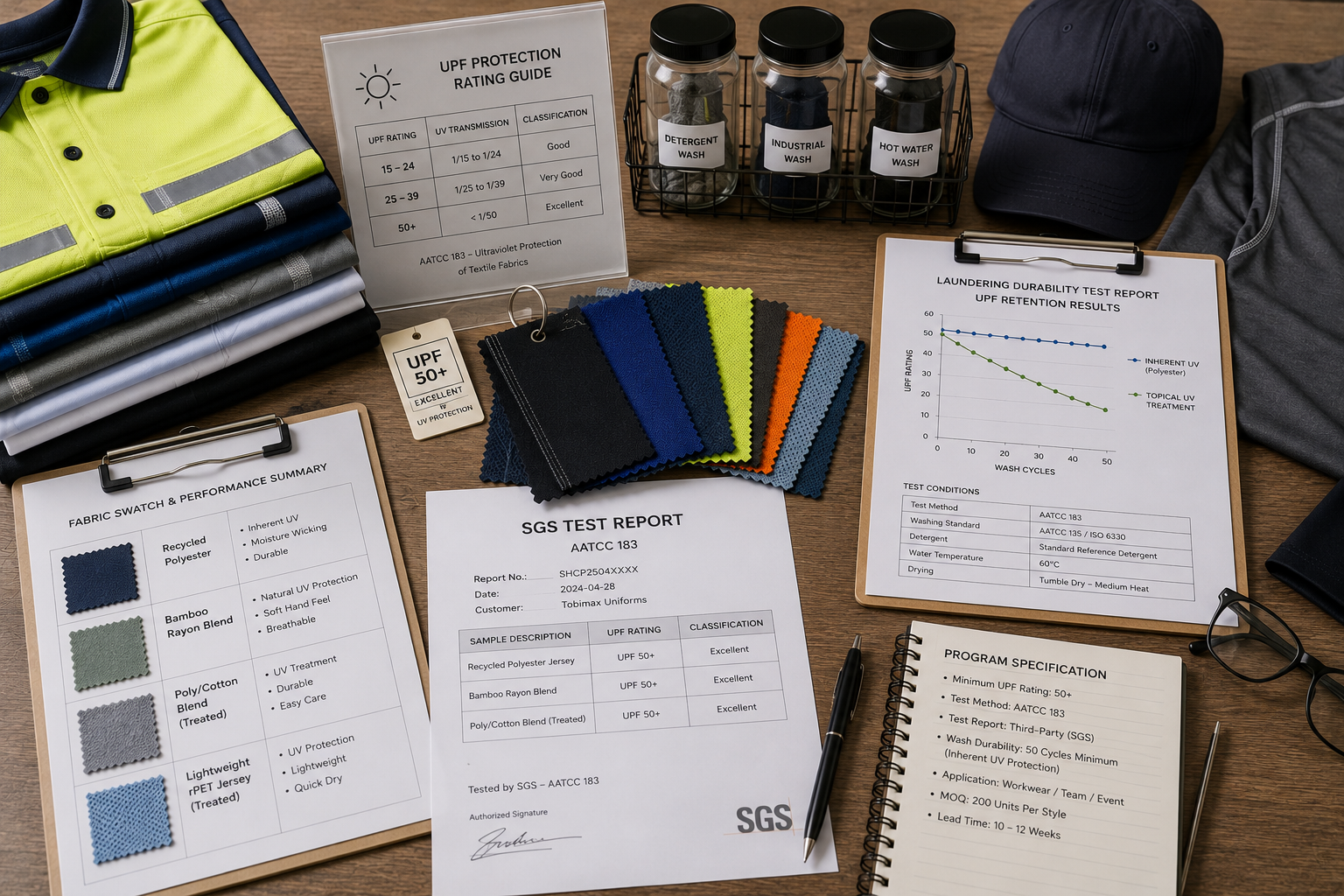
For industrial laundering (the workwear question that consumer UV brands rarely address):
Inherent UV protection (built into fibre and weave) holds indefinitely
Topical UV treatments typically hold for 20 to 40 home-wash cycles, fewer under industrial laundering
For crews washing uniforms 5 times per week at high temperatures, the topical-treatment math gets short. Inherent UV is the durable specification.
Tobimax's UV-rated uniform capability
As a marathon merchandise manufacturer and ethical garment producer, Tobimax produces UV-protective uniforms across all three categories above at UPF 30 and UPF 50+ (the two most-specified ratings), using inherent-UV fabrics where durability matters most. UPF testing is conducted by SGS to the AATCC 183 standard, with reports provided per production lot. MOQ 400 units per style. Lead time 10 to 12 weeks from approved sample.
Talk to Tobimax about UV-rated uniform programmes
If you're sourcing UV-protective uniforms for your outdoor crew, sports team, or marathon merchandise programme, contact our team to discuss your project. Tobimax is a marathon merchandise manufacturer and uniform producer with 30 years of family-owned production, low MOQ (400 units per style), and factories in Vietnam and China. We'll share our Partner Profile, UPF test report samples for the fabric you're considering, and confirm whether your programme timeline fits our production calendar.
FAQ
What's the UPF rating for workwear uniforms?
UPF 50+ is the standard target for occupational UV protection. It blocks 98% of UV radiation. Lower UPF ratings (15 to 39) provide good and very-good protection but are not typically specified for programmes where UV exposure is the driving requirement.
Is UV-protective fabric just polyester?
No. Densely woven polyester reaches UPF 50+ naturally because the weave is tight, but bamboo rayon, Tencel lyocell, and treated cotton blends can all hit UPF 50+ with appropriate construction or treatment. Fibre choice typically follows the use-case (comfort, durability, breathability) rather than UV rating alone.
Does UV protection last through industrial laundering?
Inherent UV protection (built into the fibre and weave) holds indefinitely, including under industrial laundering. Topical UV treatments degrade faster under hot industrial washes, typically losing rating after 15 to 25 cycles. For workwear, inherent protection is the durable spec.
Can race tees be UV-rated without losing the souvenir feel?
Yes. Lightweight rPET with UV treatment delivers UPF 50+ at a hand feel close to traditional race-tee polyester. Cotton-rich blends with UV treatment work for events prioritising comfort over wicking performance. Both are produced at MOQ 400 units per style.
What's the MOQ for UV-rated team uniforms at Tobimax?
Tobimax's MOQ for UV-rated team uniforms starts at 400 units per style and colourway. For larger programmes (1,000 to 50,000+ units), per-unit costs come down significantly. Lead time is 10 to 12 weeks from approved sample. UPF testing by SGS to the AATCC 183 standard, at UPF 30 or UPF 50+ depending on programme spec.