
Functional Baby Clothing: Three Trends Reshaping Founder Briefs in 2026
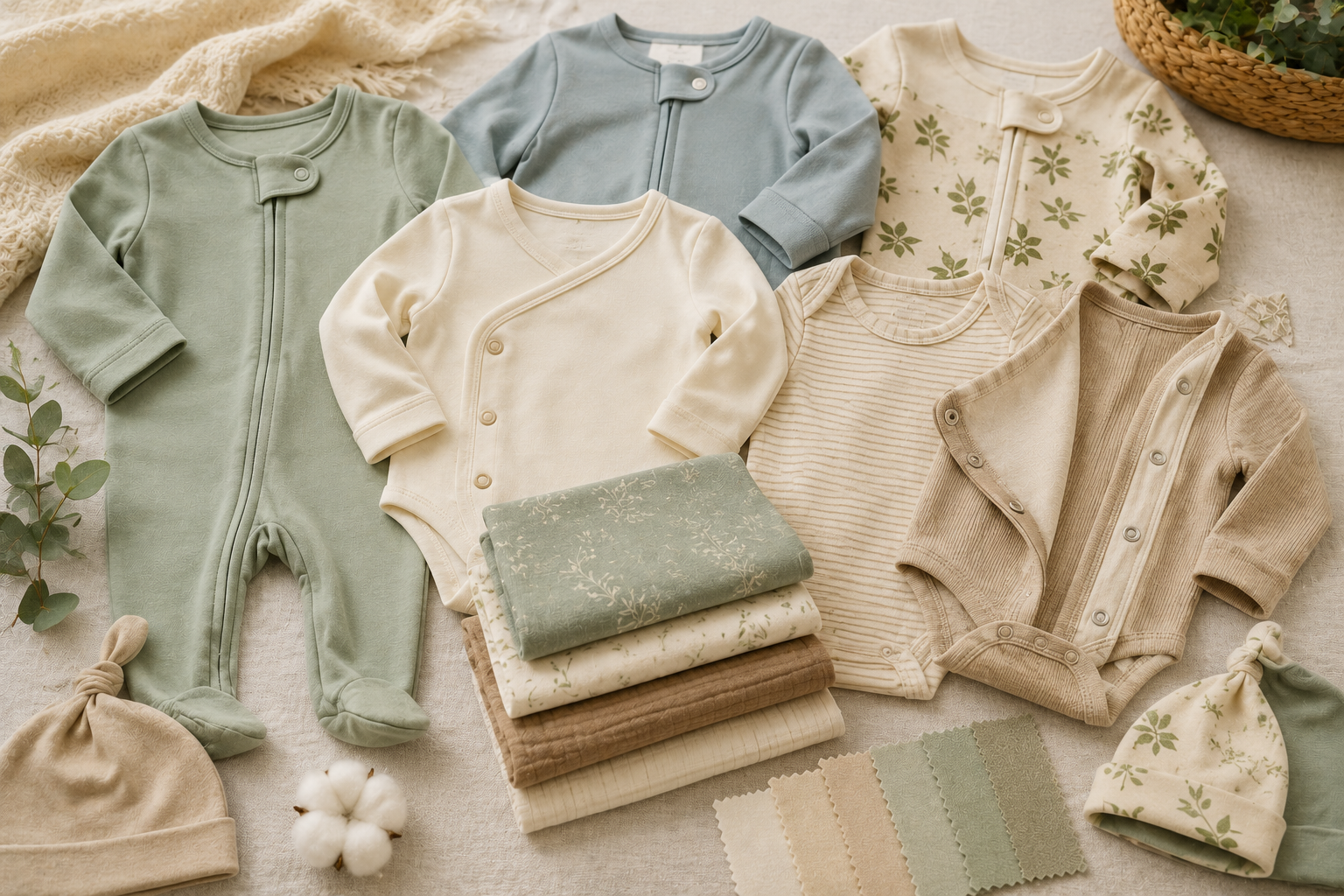
What we're seeing change
Over the past 18 months, the briefs we receive from baby brand founders at Tobimax (a family-owned children’s clothing manufacturer since 1988) have shifted in a consistent direction. Less emphasis on aesthetics alone, more emphasis on what the garment does. Three trends in particular are reshaping how brands brief their manufacturing partners.
This is a manufacturer's view of the landscape, not a product review. The three trends below are the ones we hear about most often in first-call inquiries.
Trend 1: Adaptive and sensory-friendly construction
The sensory-friendly and adaptive baby clothing segment was niche five years ago. In 2026, it sits in three places at once: a growing standalone category for children with sensory processing differences, a sub-category within mainstream baby brands' offering, and a default expectation among premium baby buyers.
What's changing in the briefs:
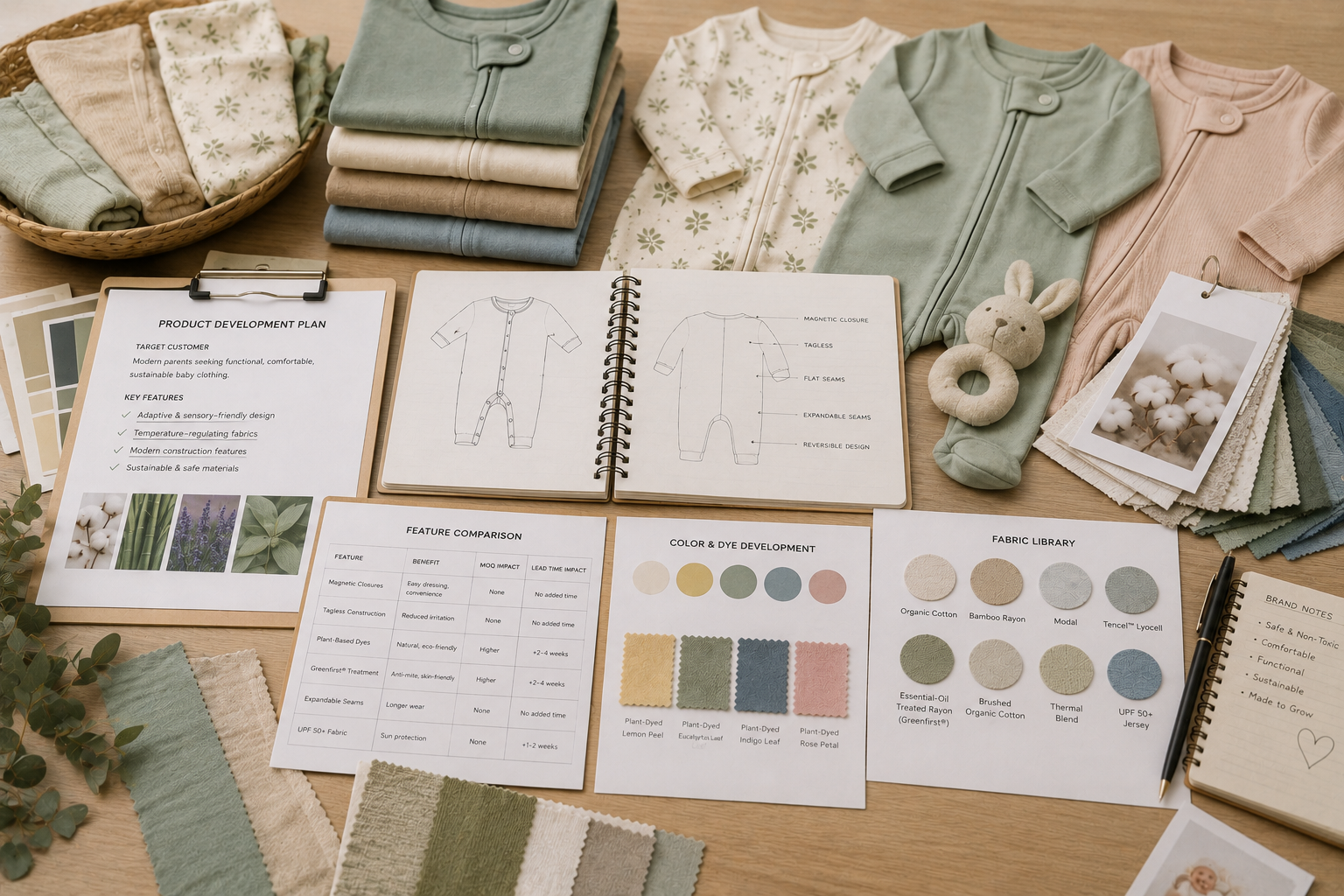
Magnetic closures instead of snaps, especially on overnight-wear and quick-change pieces. Reduces dressing time, eliminates pinch points, and makes one-handed dressing possible for caregivers managing siblings simultaneously
Tagless construction with printed-on labels or external tag placement. The seam against neck skin is the most common irritation point
Flat seam construction rather than overlocked seams on inside-skin contact surfaces
Sensory-soft fabrics like brushed organic cotton, bamboo rayon, and modal — chosen specifically for the hand feel rather than the durability spec
The buyer driver is real. Children with sensory processing differences, eczema, and other skin-condition sensitivities form a growing visible market. The brands serving this segment are also (correctly) discovering that "sensory-friendly" features make the product better for everyone.
Trend 2: Temperature-regulating and condition-responsive fabrics
The second trend is about what the fabric does once the garment is on the baby.
Climate-adaptive bamboo rayon. Bamboo rayon's natural breathability and moisture management make it the default temperature-regulating fibre for warm-climate baby brands. The hand feel matters but so does the wicking rate
Anti-mite essential-oil treatments for sleepwear and bedding. Greenfirst-treated rayon (lemon, lavender, eucalyptus essential oils, geraniol active compound) addresses the dust-mite exposure that drives paediatric asthma and eczema flares. We've covered this in depth in our essential-oil rayon piece
Thermal-regulating blends for transition-season pieces. Bamboo-cotton blends and modal blends are increasingly briefed for spring/autumn product lines where parents want one garment to span temperature ranges
The buyer driver here is parent-fatigue. Parents want fewer garments doing more, not more garments stratifying narrowly by temperature.
Trend 3: Modern construction features (closures, seams, dyes)
The third trend is about everything the garment is made of that isn't fabric.
Magnetic closures (overlap with Trend 1 but with a different buyer driver — convenience, not sensory)
Expandable seams that grow with the baby, extending wear from 3 months to 6 months on a single garment
Plant-based dyes for colour. Botanical dyes are no longer a craft-fair anomaly. Several mid-scale baby brands now spec lemon-yellow dyed in lemon-peel extract, blue dyed in indigo plant, etc.
Footed pieces with grippy soles moulded directly into the fabric rather than glued patches
Reversible designs that double the wear life of one garment
The buyer driver across all of these is value-per-garment in a tightening consumer-spending environment.
How these three trends interact
The most interesting briefs we're seeing combine all three:
This is a buyer asking for a premium SKU with the price point to support it. Not every brand can sustain this stack, but the briefs are landing more often.
How functional features affect MOQ and lead time
| Feature | MOQ implication | Lead time implication |
|---|---|---|
| Magnetic closures | None at MOQ 400 | No added time |
| Tagless construction | None | No added time |
| Plant-based dyes | Higher (colour-development minimums) | Add 2 to 4 weeks for dye development |
| Greenfirst® essential-oil treatment | Higher (treatment-run minimums) | Add 2 to 4 weeks for treatment |
| Expandable seams | None at MOQ 400 | No added time |
| UPF 30 / UPF 50+ rated fabric | None | Add 1 to 2 weeks for UPF lab certification |
The features that hold MOQ at 400 are the easiest to layer onto a first production run. Plant-based dyes and Greenfirst® treatment carry their own per-batch minimums on top of the garment MOQ, which is worth scoping at brief stage rather than late in sampling.
What we tell brands to do with these trends
Three observations we share with founders briefing their first or next baby line:
Don't stack all three trends at once. Each one adds cost. The brief that wins is the one where the functional feature aligns with the brand's positioning, not the one that ticks every box
Test sensory feedback before committing. A magnetic closure that works for one caregiver might be confusing for another. Send 5 to 10 samples to parent reviewers before locking the production spec
Be honest about the trade-offs in your marketing. Plant-based dyes shift over time. Magnetic closures cannot go in the microwave for sterilising. Expandable seams may slacken with stretch. Honest disclosure beats inflated claims
The brands we partner with (Whistle & Flute, Jax & Lennon, Little Sleepies) have all navigated some version of these trade-offs in their product development. The pattern is the same. Start with the feature that matches your brand. Add others as the SKU range expands.
Talk to Tobimax about functional baby clothing production
If you’re a founder briefing your next baby or children’s clothing manufacturer, contact our team to discuss your project. Tobimax is a family-owned, female-led ethical garment manufacturer making children’s apparel since 1988, with low MOQ clothing manufacturer minimums starting at 400 units per style, factories in Vietnam and China, and capability across magnetic closures, tagless construction, Greenfirst essential-oil treatments, plant-based dyes, expandable seams, and our signature fabric library. We’ll share our Partner Profile, walk through how functional features affect MOQ and lead times, and confirm whether your brief fits our production calendar.
FAQ
What does "functional baby clothing" actually mean?
Functional baby clothing refers to garments where features beyond aesthetics drive the product. The three dominant trends in 2026 are adaptive construction (magnetic closures, tagless, sensory-soft fabrics), temperature regulation (bamboo, Greenfirst treatments, climate-adaptive blends), and modern features (expandable seams, plant-based dyes, reversible designs).
Are magnetic closures safe for babies?
Yes, when designed and tested correctly. Commercial magnetic closures for baby clothing use enclosed magnets with cover fabric to prevent direct skin contact and meet CPSIA safety standards. Independent tested-magnet closures from suppliers like Magnetic Me are widely used at the production scale.
Can I produce sensory-friendly baby clothing at MOQ 400?
Yes. Tagless construction, flat seam finishing, brushed organic cotton, bamboo rayon, magnetic closures, and expandable seams are all achievable at MOQ 400 units per style. Specialty features like plant-based dyes and Greenfirst® essential-oil treatment carry their own per-batch minimums on top of the garment MOQ.
Which functional features add MOQ minimums?
Plant-based dyes and Greenfirst® essential-oil treatment carry their own per-batch minimums on top of the garment MOQ, because the dye lot and treatment run need to meet supplier-side thresholds. Magnetic closures, tagless construction, expandable seams, and UPF-rated fabrics typically hold at MOQ 400 per style. We recommend brands scope colour-development and treatment minimums at brief stage rather than late in sampling.
Which functional features does Tobimax produce?
Tobimax produces magnetic closures, tagless construction, plant-based dyes, Greenfirst essential-oil treated rayon, expandable seams, UPF 50+ rated fabrics, and combinations across our signature fabric library (organic cotton, bamboo rayon, modal, Tencel, essential-oil treated rayon). All at MOQ 400 units per style.