Low MOQ Sleepwear Manufacturing: How to Launch a Pajama Line Without Ordering 5,000 Units
The biggest barrier to launching a sleepwear brand isn't the idea or the design — it's the minimum order quantity.
Most overseas factories want 2,000 to 5,000 units per style, per color. For a first-time founder testing a new market with limited capital, that's a $30,000 to $80,000 bet on unproven demand. It's how brands end up with a garage full of unsold inventory in sizes nobody ordered.
Low MOQ sleepwear manufacturing changes that math entirely. Starting with 500 units per style lets you validate your product in the real market, learn what actually sells, and scale up based on data instead of guesswork.
Here's how to think about low-minimum manufacturing and how to find a partner who won't sacrifice quality for smaller runs.
Why Most Factories Have High Minimums
It's worth understanding why minimum order quantities exist in the first place. Factories set MOQs to cover their fixed costs — machine setup, fabric ordering minimums from mills, pattern preparation, and the inefficiency of switching between short production runs. A factory optimized for 10,000-unit runs makes less money on a 500-unit order even if the per-unit price is higher.
That's why the factories with the lowest MOQs (50 to 100 units) often deliver inconsistent quality — they're running so many small orders that quality control suffers, and their fabric sourcing is limited to whatever stock fabric is available rather than custom orders from mills.
The sweet spot for emerging sleepwear brands is a manufacturer who can work at 500 to 1,000 units per style while still maintaining custom fabric sourcing, quality production, and proper compliance testing. That's high enough to get reasonable fabric pricing and production efficiency, but low enough to protect your capital.
What You Can Achieve With a 500-Unit First Run
A 500-unit order is surprisingly powerful when deployed strategically. Here's what a smart launch looks like.
One core style — say, a children's two-piece bamboo pajama set — in 3 to 4 prints or colors. At 500 units split across 4 colorways, that's roughly 125 units per colorway, spread across 5 to 6 sizes. That gives you enough inventory to stock your online store for launch, fulfill 2 to 3 months of initial sales, identify your bestselling colorway and reorder quickly, and send samples to a handful of boutique wholesale accounts.
Total investment for a 500-unit first production run (including sampling, fabric, production, testing, and freight): approximately $5,000 to $8,000 depending on fabric and complexity. That's a realistic starting budget for a funded founder or a side-project launch.
The insight you gain from those 500 units — which colors sell, which sizes you need more of, what customers say about the fit — is worth more than any market research.
What to Look For in a Low-MOQ Manufacturer
Not all low-MOQ manufacturers are equal. Here's what separates a genuine emerging-brand partner from a factory that just takes small orders reluctantly.
Custom fabric sourcing, not just stock fabric. The best partners can source fabric from mills even at lower volumes because they aggregate orders across multiple clients. This means you get your specific bamboo rayon/spandex blend, not whatever cotton jersey they have in the warehouse.
In-house pattern making and grading. If you're providing a tech pack or a reference sample, your manufacturer should be able to develop the pattern and grade it across your size range. Sending you back and forth to a separate pattern maker adds weeks and cost.
Compliance knowledge built in. For children's sleepwear, CPSIA testing and tight-fit dimensional requirements need to be part of the process, not an afterthought you manage separately.
Transparent communication. Small orders require more per-unit attention than large runs. Your manufacturer should be responsive, proactive about potential issues, and comfortable explaining every line item on your invoice.
Reorder capability. The whole point of starting small is to reorder fast when something sells. Your manufacturer should be able to turn around a reorder in 4 to 6 weeks, not restart the entire sampling process.
The Cost Trade-Off of Low MOQ
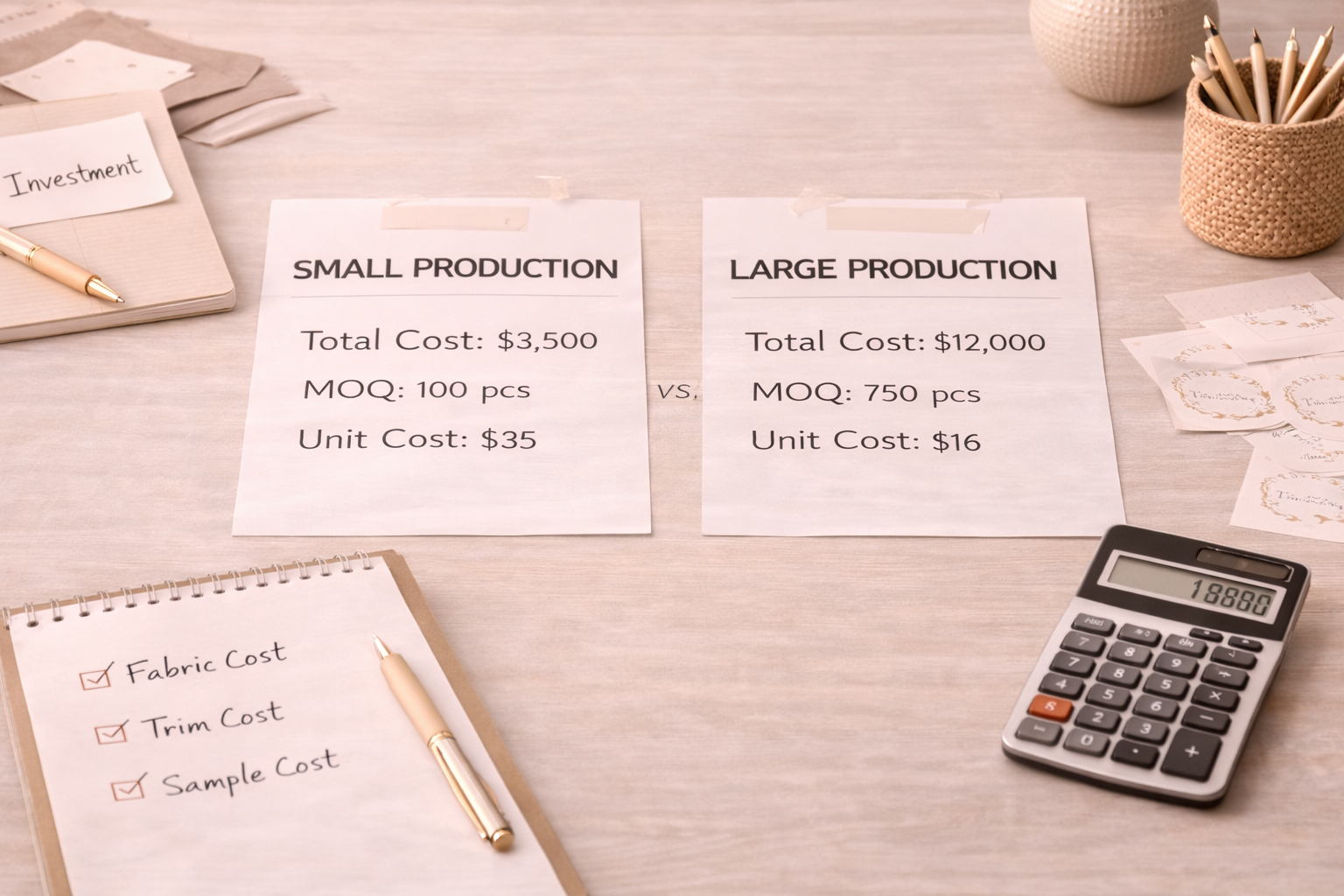
Let's be honest: your per-unit cost at 500 units will be higher than at 5,000 units. Typically 15 to 25 percent higher, because fixed costs are spread across fewer units and fabric pricing is less favorable at lower volumes.
But the total capital at risk is dramatically lower. Spending $7,000 to produce 500 units you can sell through is vastly better than spending $40,000 to produce 5,000 units that sit in a warehouse because you guessed wrong on colors or sizing.
The goal isn't to minimize per-unit cost on your first order. The goal is to learn fast and scale profitably. Your second order — once you know your bestsellers — is where costs start to drop.
Scaling From 500 to 5,000 Units
The path from first order to full production typically looks like this.
Order 1 (500 units): test the market, identify bestsellers. Order 2 (1,000 to 1,500 units): double down on what's working, cut what isn't. Add 1 to 2 new prints. Order 3 (2,000 to 3,000 units): scale your proven styles, negotiate improved fabric pricing. Introduce a second style (like a onesie or sleep sack). Order 4+ (3,000 to 5,000 units): seasonal planning, wholesale accounts, expanded size range.
Most brands reach the 2,000+ unit level within 12 to 18 months if their product-market fit is strong. At that point, your per-unit cost has dropped 20 to 30 percent from your first order, and your reorder process is dialed in.
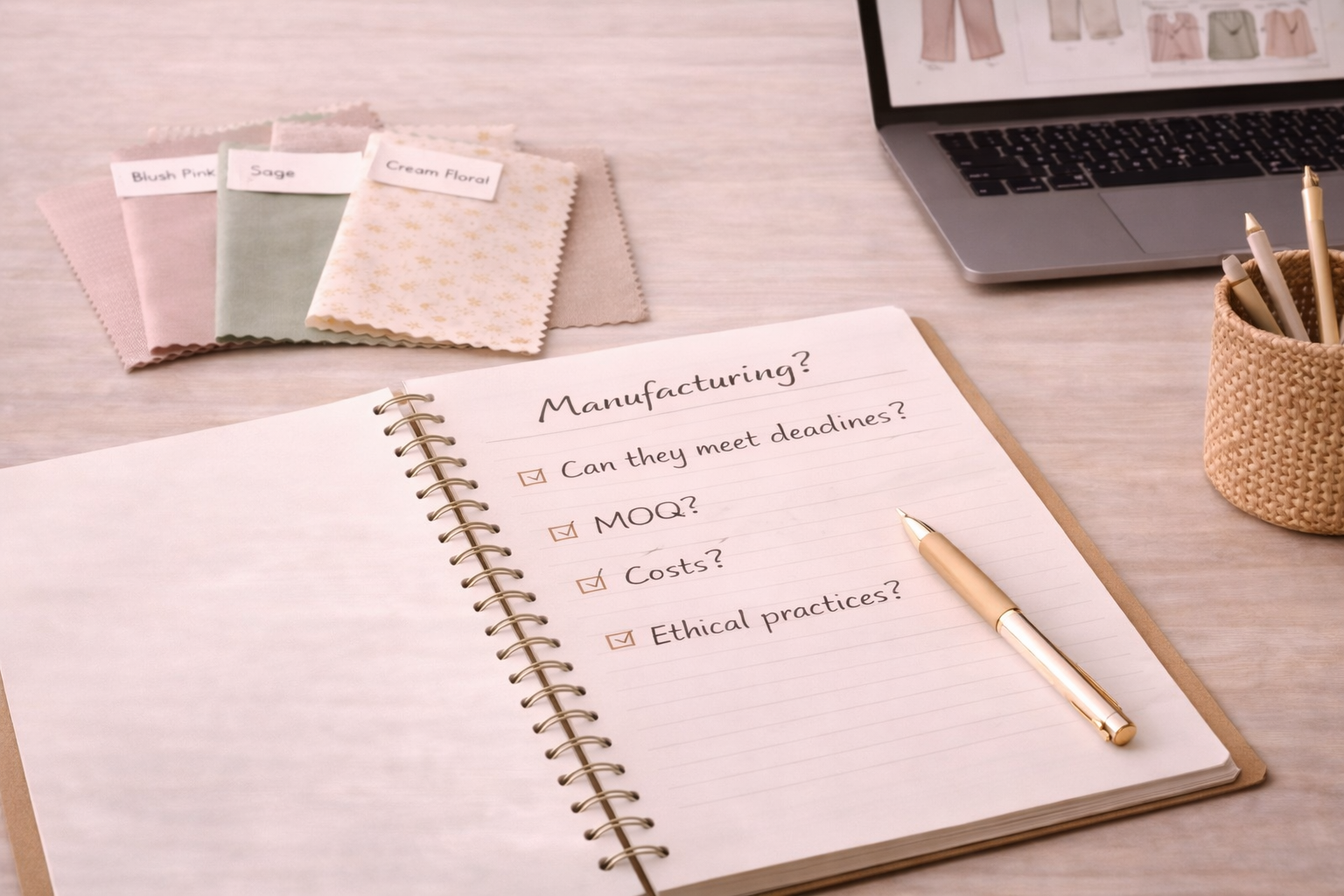
Questions to Ask Before Your First Order
When you're evaluating a low-MOQ sleepwear manufacturer, here are the questions that matter most.
What is your true minimum per style, per color — not the number on your website, but the minimum you'll actually produce to your full quality standard? How do you source fabric at lower volumes, and will I have access to custom fabric options or only stock? What's your lead time from order to delivery for a 500-unit run? Do you handle CPSIA compliance testing, or is that my responsibility? What does your sampling process look like, and how much does it cost? Can you show me examples of children's sleepwear you've produced for other brands at similar volumes? What's your defect rate, and how do you handle quality issues?
The answers to these questions will tell you more about a manufacturer's capabilities than their website ever will.