
GOTS Organic Cotton for Children's Sleepwear: A Manufacturer's Guide
What GOTS actually certifies (and what it doesn't)
GOTS, the Global Organic Textile Standard, is the leading third-party certification for organic-fibre textile production. It covers the entire supply chain, from the cotton field through ginning, spinning, dyeing, cutting, sewing, packing, and labelling. A garment labelled GOTS-certified means every step in that chain has been audited by an accredited body and the paperwork can be traced from finished good back to farm.
What GOTS does cover:
Minimum 95% certified organic fibre content (Organic grade) or 70% (Made With Organic grade)
Banned inputs: AZO dyes, formaldehyde, chlorine bleach, heavy metals, certain flame retardants, synthetic pesticides at farm level
Worker rights: no forced or child labour, freedom of association, safe working conditions, training in fire prevention
Wastewater treatment + chemical input registry at every processing step
What GOTS does not cover:
Carbon footprint (separate metric, not in GOTS scope)
Microplastic shedding (only relevant for blends with synthetic fibres)
Specific water consumption thresholds (covered indirectly via process controls)
Why this matters for children's sleepwear
Three reasons retail buyers increasingly require GOTS for children's wear:
Skin and chemical safety. Children's skin is thinner than adult skin and absorbs more readily. A 2024 study from a Swedish children's hospital recorded a 78% reduction in skin irritation cases among sensitive paediatric patients after switching to GOTS-certified uniforms. Buyers reference data like this when evaluating supplier claims.
Retail compliance. Major retailers (Target's GoodHomes range, Nordstrom's organic kids' collections, Whole Body) require GOTS certification for any "organic" claim in children's product categories. "Made with organic cotton" is not the same as GOTS-certified, and buyers know the difference.
Pricing premium. GOTS-certified children's wear consistently commands a 25 to 40% retail premium versus conventional cotton equivalents, with strong sell-through. One US children's brand reported a 35% lift in average unit revenue after transitioning to GOTS-certified production.
The environmental case, with numbers
| Metric | Conventional Cotton | GOTS Organic Cotton |
|---|---|---|
| Water consumption | Baseline | Up to 91% less |
| Synthetic pesticide use | Standard | Prohibited |
| Soil health | Degrades over time | Builds organic matter |
| Worker chemical exposure | Variable | Banned input list |
| Genetic modification | Permitted | Prohibited |
| Traceability | None to spotty | Full chain audit |
GOTS vs OEKO-TEX vs "organic cotton" without certification
This is where most buyers get tripped up. Three labels that sound similar mean very different things.
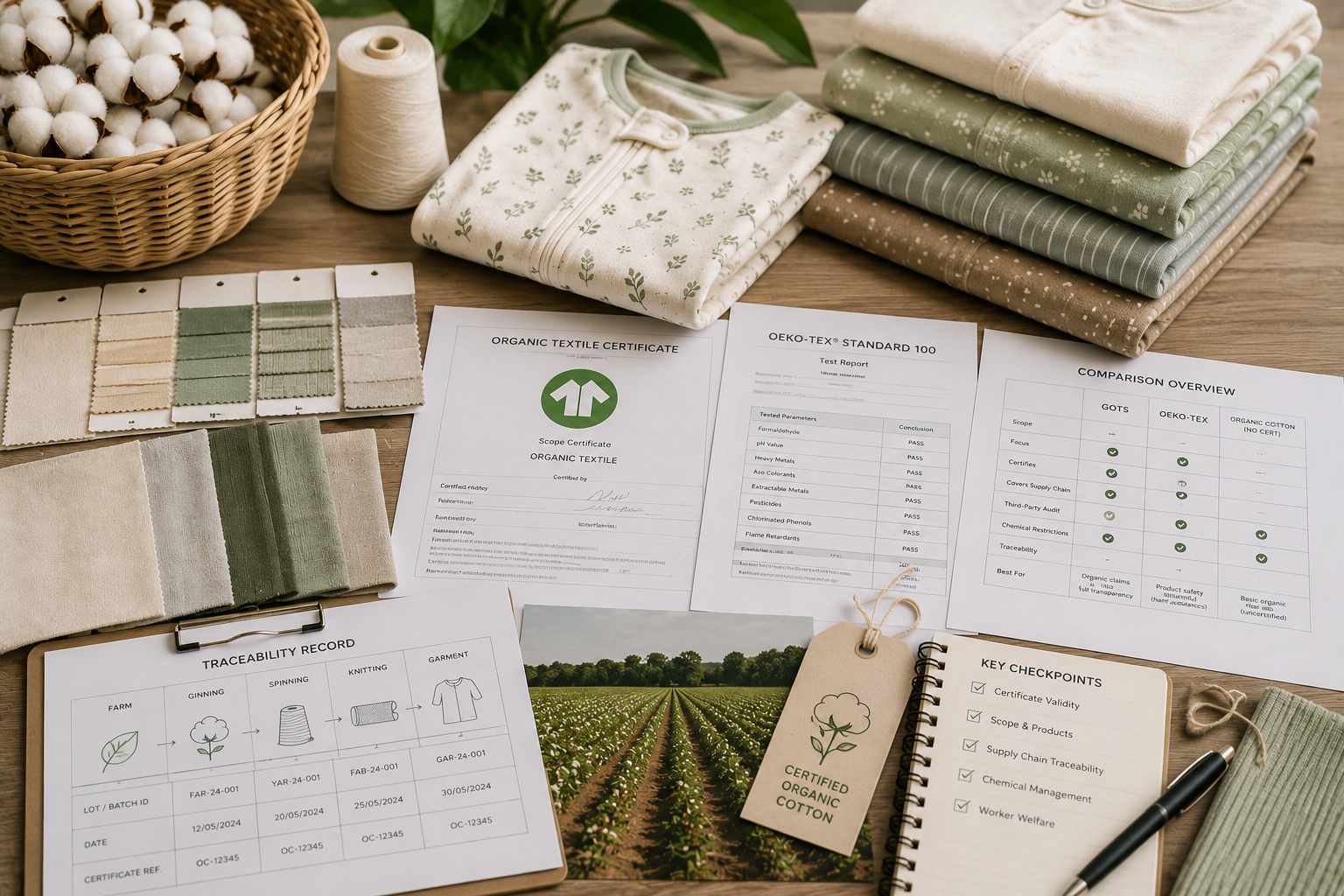
GOTS: end-to-end supply chain. Tracks the cotton from farm to finished garment. Highest assurance.
OEKO-TEX Standard 100: tests the finished fabric for over 100 harmful substances. It's a product test, not a process test. It tells you what's in the fabric today, not how it was grown or who made it.
"Organic cotton" (no certification): marketing language. Without a third-party cert, anyone can claim it. Some claims are real, many are not.
Founder-led kids brands often start with OEKO-TEX (easier to obtain) and upgrade to GOTS once they hit the retail-buyer requirements. Tobimax can produce to either, plus dual-certified.
One gap worth flagging: none of these three certifications cover flammability. GOTS and OEKO-TEX both speak to fibre and chemical safety, not burn performance. A GOTS-certified fabric still has to pass one of the two CPSIA compliance paths, snug-fit construction or flame-resistant treatment, before it can legally be sold as children's sleepwear in the U.S.
Vetting a manufacturer's GOTS claim in 3 questions
"Show me the certificate." The certificate names the certifying body (one of the accredited bodies under the GOTS umbrella), the scope (which products and which facilities), and the audit date. A real manufacturer can email this in under 24 hours.
"Which mills supply your GOTS cotton, and are their certificates valid for the production window?" This catches the most common shortcut. A factory might be GOTS-certified, but if their cotton mill's cert lapsed before production started, the finished good doesn't qualify.
Can I see the lot traceability for an order I place?" A real GOTS supply chain produces a per-lot trace. Yarn lot → fabric lot → cutting batch → garment. If your manufacturer can't provide this on request, the certificate isn't being used as intended.
Tobimax's GOTS supply chain
Tobimax has been a GOTS-certified organic baby clothing manufacturer and children's sleepwear manufacturer for over a decade, certified at the Organic grade (≥95% certified organic fibre content) by OneCert. Our cotton sources sit across South Plains (US), Turkey, and India, with vertical integration from yarn spinning through finished garment. The brands we partner with (Whistle & Flute, Jax & Lennon, Little Sleepies) chose us because the paperwork holds up when their retail buyers ask for it.
Talk to Tobimax about GOTS organic cotton production
If you’re a children’s sleepwear manufacturer client or an organic baby clothing manufacturer client evaluating your next production partner, contact our team to discuss your project. Tobimax is a family-owned, female-led ethical garment manufacturer since 1988, with GOTS-certified organic cotton experience, low MOQ (400 units per style), and factories in Vietnam and China. We’ll share our Partner Profile, the GOTS certificate scope, and confirm whether your timeline fits our production calendar.
FAQ
What does GOTS certification actually mean?
GOTS (Global Organic Textile Standard) certifies the entire supply chain of an organic-fibre garment, from field through finished good. It requires at least 95% organic fibre content, bans a long list of harmful inputs (formaldehyde, AZO dyes, heavy metals, certain flame retardants), and audits worker rights at every facility in the chain.
Is GOTS the same as OEKO-TEX?
No. GOTS audits the whole supply chain (process certification). OEKO-TEX Standard 100 tests the finished fabric for harmful substances (product certification). Many brands carry both because they answer different buyer questions.
Why does GOTS organic cotton cost more than conventional cotton?
Three reasons. First, organic farming yields per acre are typically 20 to 40% lower without synthetic inputs. Second, the certification audit costs are real (annual fees per facility). Third, the supply is constrained relative to demand. The 25 to 40% retail premium typically more than offsets the manufacturing cost differential.
What's Tobimax's MOQ for GOTS organic cotton sleepwear?
Tobimax's MOQ for GOTS-certified organic cotton children's sleepwear starts at 400 units per style and colourway. Lead times are 8 to 10 weeks from approved sample, with sampling 2 to 4 weeks ahead.
Do retail buyers require GOTS, or is OEKO-TEX enough?
For children's organic collections at major retailers (Target, Nordstrom, Whole Body), GOTS is increasingly required. For general kids' collections without an "organic" claim, OEKO-TEX often satisfies. The trend in retail compliance is moving toward GOTS for any product positioned as organic or sustainable in children's categories.