
Children's Holiday Pajamas: Safety Standards Without the Chemicals
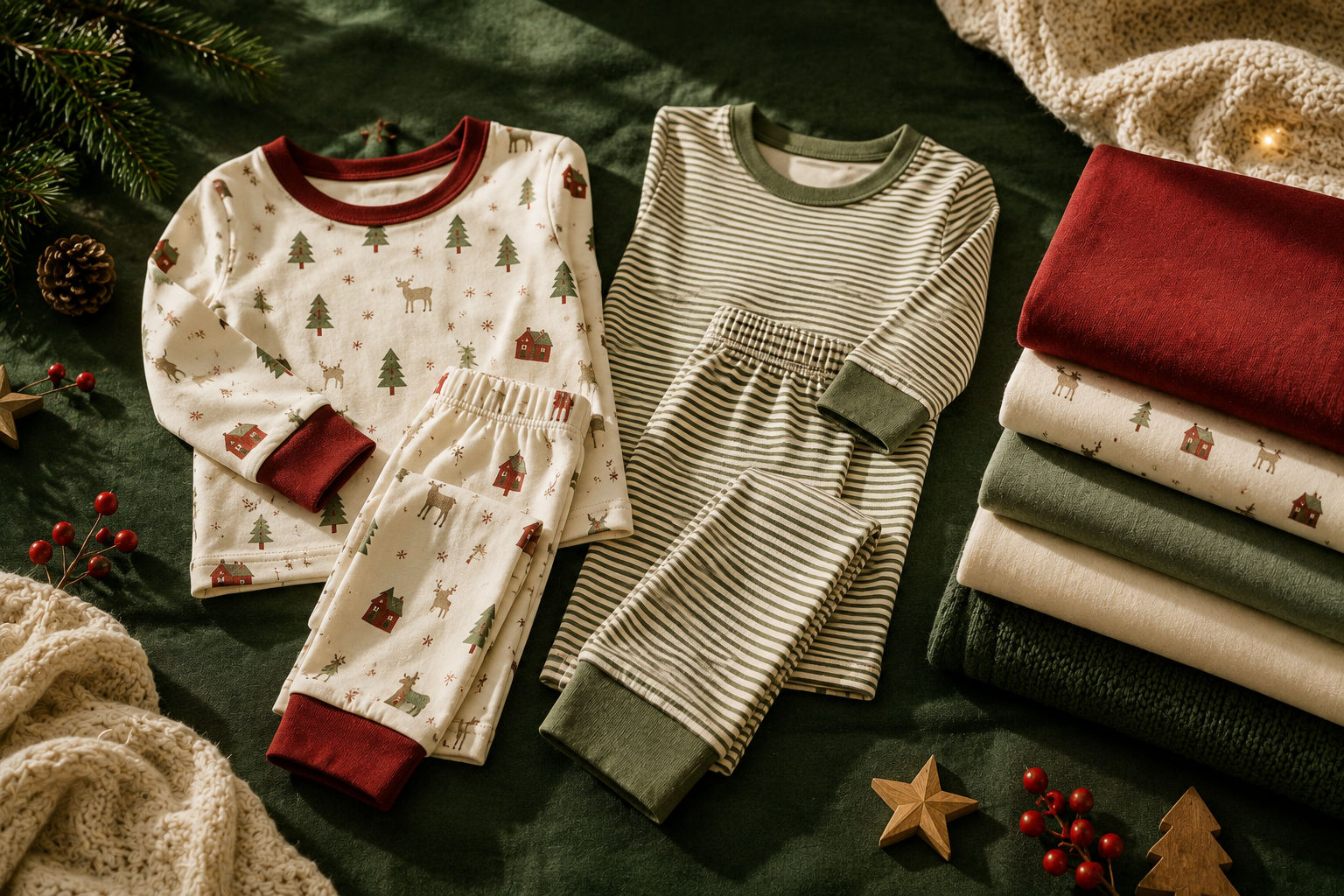
Why holiday pajamas get extra scrutiny
Holiday pajamas (matching family sets, character licenses, novelty prints) are the highest-volume children's sleepwear category in the U.S. retail calendar, concentrated in October through December. The volume creates two pressures.
First, retail buyers expect compliance documentation as part of the purchase order. CPSIA general certificates of conformity (GCCs) are non-negotiable.
Second, consumer attention to "what's in this fabric" has risen sharply. Parents searching "non-toxic holiday pajamas" or "chemical-free flame-resistant pajamas" are looking specifically for sleepwear that meets the legal safety bar without using flame-retardant chemistry.
For a brand selling holiday pajamas, the answer to this is not marketing language. It's choosing the right CPSIA compliance pathway at the construction stage. Brands evaluating children's sleepwear production often benefit from a full pathway comparison before choosing between snug-fit and FR-treated construction.
The two CPSIA compliance paths
U.S. children's sleepwear sized 9 months through size 14 must meet 16 CFR 1615 or 1616 (sizes 9 months to 6X under 1615, sizes 7 through 14 under 1616). Two paths to compliance:
Path 1: snug-fit construction. The garment passes by sitting close to the body within defined measurement tolerances. No flame-retardant chemistry is required. This is the route most ethical manufacturers use.
Path 2: flame-resistant fabric. The fabric is treated with FR chemistry to meet the legal burn-rate. The garment can then be loose-fitting.
Holiday pajamas are typically marketed as cozy, snug, family-matching. The snug-fit path fits the product type and removes the FR chemistry question entirely.
How the snug-fit pathway actually works
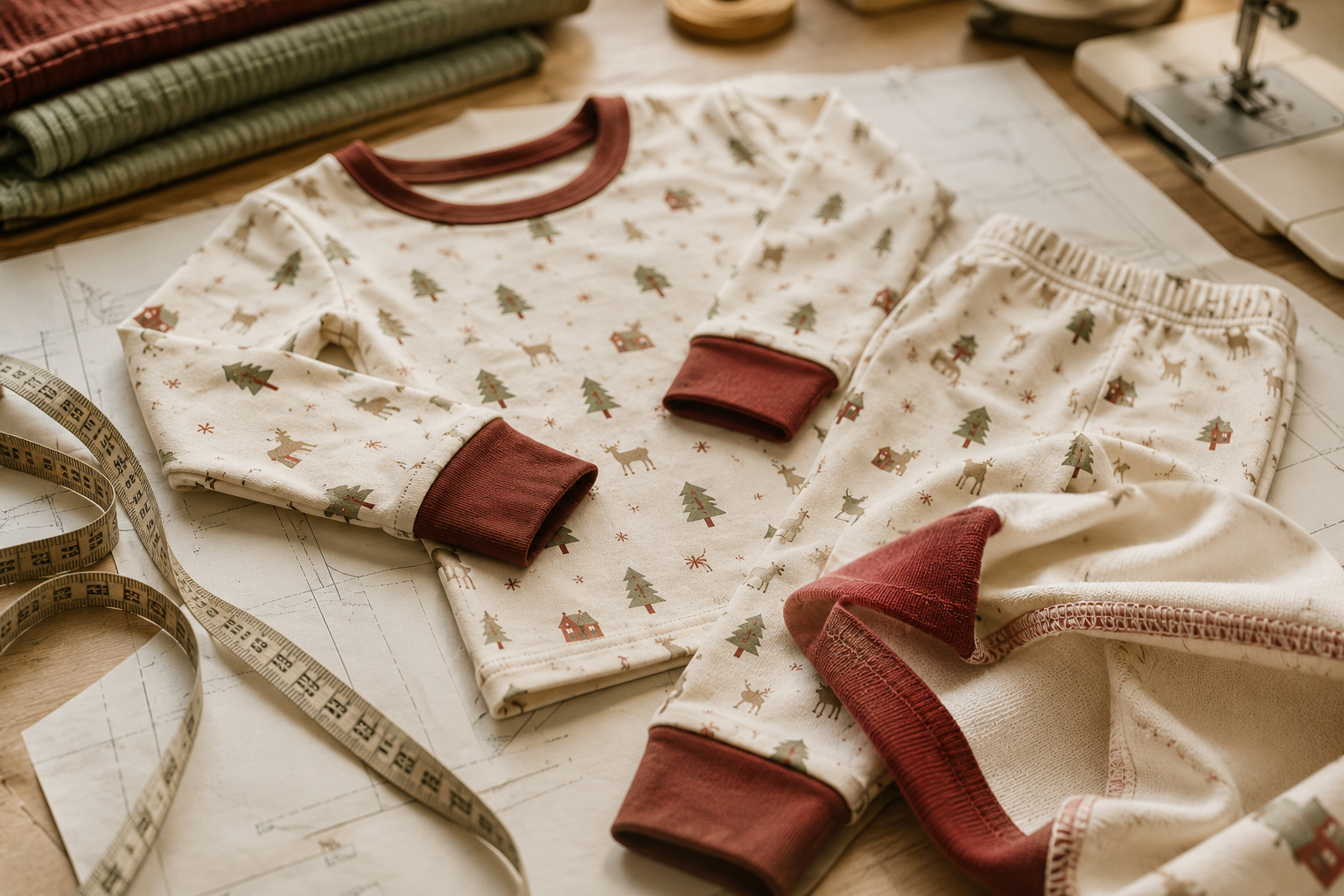
Snug-fit is a dimensional standard. The pattern must hold the garment within specific tolerances at chest, waist, hips, thigh, knee, arm width, and wrist. The tolerances are different at each size break.
The construction implications:
- Pattern grading must be tighter than for daywear. A child's pajama set graded at typical daywear ease will fail.
- Fabric stretch must support the snug fit. Most snug-fit children's pajamas use a 95% cotton 5% spandex interlock, a bamboo-spandex blend, or 100% cotton ribbed knit.
- Fabric weight typically lands at 180 to 220 GSM for a standard winter holiday pajama, or 140 to 180 GSM for a lighter summer pajama.
- Trims (necklines, cuffs, waistbands) must hold to the body without compressing.
The CPSC-accepted testing labs verify dimensional compliance against the standard. Testing per fabric, per colourway, and per size break.
Fabric options for chemical-free holiday pajamas
| Fabric | GSM range | Sustainability cert | Best for |
|---|---|---|---|
| GOTS organic cotton interlock | 180 to 220 | GOTS | Premium positioning, traceability story |
| OEKO-TEX cotton ribbed knit | 160 to 200 | OEKO-TEX 100 | Mid-tier price point, soft hand |
| Bamboo viscose blend (95/5 with elastane) | 160 to 200 | OEKO-TEX 100 | Drape-forward, moisture-wicking |
| Cotton modal blend | 180 to 220 | OEKO-TEX 100 | Premium hand feel, less pilling |
| Recycled cotton blend | 180 to 220 | GRS, OEKO-TEX 100 | Sustainability story without organic premium |
Chemicals to avoid (and ask about)
The snug-fit pathway removes the FR chemistry question. There are still chemistry questions worth asking your manufacturer:
- Formaldehyde-based wrinkle-resistant finishes. Avoid for sleepwear. Look for OEKO-TEX 100 certification, which screens for formaldehyde residue.
- AZO dyes. Banned in EU and increasingly screened in U.S. retail spec. OEKO-TEX 100 screens these as well.
- PFAS for moisture resistance. No legitimate use case in pajamas.
- Optical brighteners. Common in conventional cotton processing. Screened out of GOTS-certified production.
The simplest screen: ask for the OEKO-TEX Standard 100 certificate of the actual fabric lot used. Not the mill's blanket certification.
Holiday pajamas timeline
For an October to December retail window:
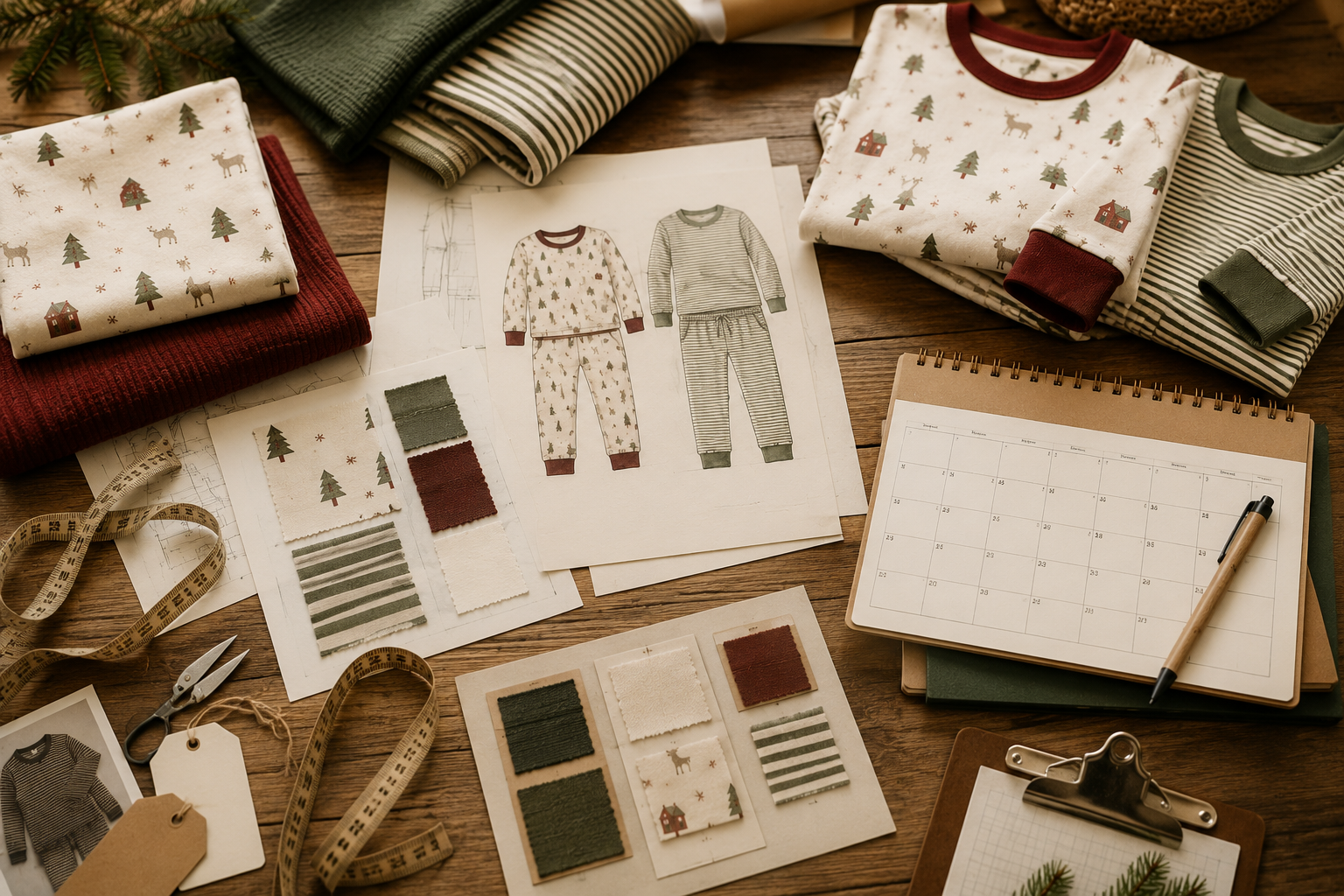
- March through April: finalize designs, fabric selection, sample request
- May: sample approval, lab testing, photo samples
- June: bulk production starts
- July through August: production, QC, finishing
- September: ship by FOB
- October onward: retail launch
The compressed timeline is possible because holiday pajamas use stable, repeating constructions. Tobimax's standard sample-to-FOB lead time of 8 to 10 weeks fits this calendar with margin.
FAQ
Can children's holiday pajamas meet CPSIA without flame-retardant chemicals?
Yes. The snug-fit pathway under 16 CFR 1615 and 1616 lets a garment pass flammability rules through dimensional construction, without any FR chemistry. Most ethical manufacturers use this pathway for holiday pajamas.
What's the MOQ for custom children's holiday pajamas?
Tobimax's MOQ for children's pajamas starts at 400 units per style and colourway, with the same minimum applying for snug-fit holiday programs.
How long does CPSIA testing take for new holiday pajama designs?
Lab testing typically runs 2 to 3 weeks per fabric and colourway combination. Build this into the timeline before bulk production.
Are GOTS organic cotton pajamas the same as snug-fit pajamas?
No. GOTS is a fibre and process certification (organic, traceable, screened chemistry). Snug-fit is a CPSIA construction pathway. A pajama can be both. Most premium brands aim for both.
When should I start a holiday pajama program for next December?
Start in March or April. With a 6 to 7 month total runway from design to FOB, you cover sampling, lab testing, bulk production, and shipping with reasonable margin.