
International Children's Sleepwear Safety: U.S. CPSIA vs EU EN 14878 vs Canada CCPSA
Why multi-region matters
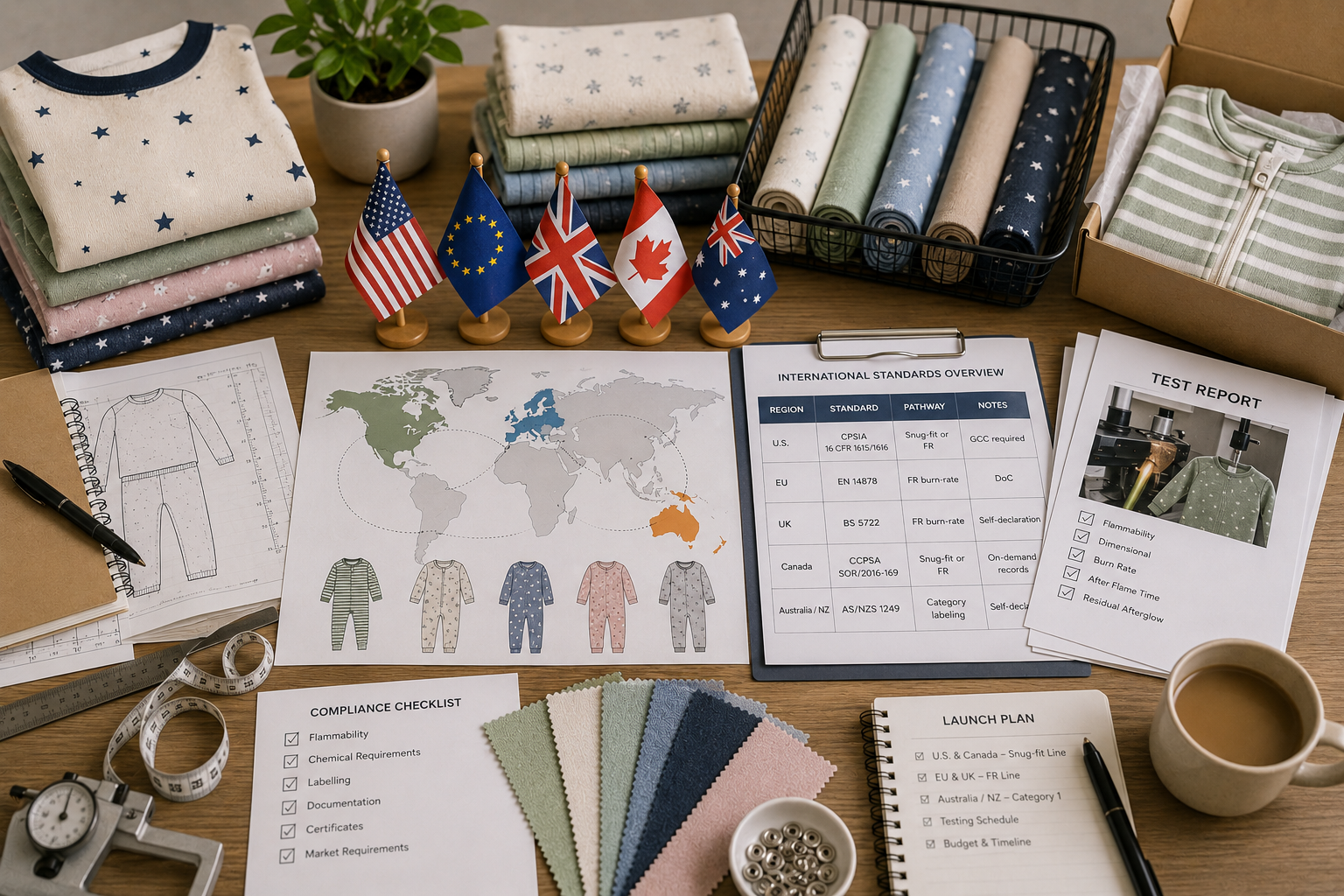
A children's sleepwear brand selling only in the U.S. has one regulatory framework to learn: CPSIA. A brand selling into Canada adds CCPSA. EU adds EN 14878. UK adds BS 5722. Australia adds AS/NZS 1249.
Each framework has its own flammability standard, labelling rules, and certificate requirements. A garment compliant in one market is not automatically compliant in another. Some standards are functionally similar; others differ in pathway and pass criteria.
For a founder building a multi-region brand from launch, getting the framework decision right at the design stage saves multiple rounds of retesting later.
U.S. — CPSIA (16 CFR 1615 and 1616)
Pathways: Snug-fit construction (16 CFR 1615.4 for sizes 9 months to 6X, 16 CFR 1616.4 for sizes 7 to 14) or flame-resistant fabric (16 CFR 1615.3 / 1616.3).
Test: Dimensional verification for snug-fit, or burn-rate testing for FR.
Certificate: General Certificate of Conformity (GCC) issued by importer.
Other CPSIA requirements: Lead content (16 CFR 1303), phthalates (CPSIA section 108), tracking labels (16 CFR 1130).
EU — EN 14878
Pathway: Burn-rate test only. EN 14878 measures flame spread and dripping behaviour.
Test: Specific burn rate criteria depending on garment category (Category A, B, or C).
Certificate: Declaration of Conformity, issued by manufacturer or importer. CE marking is not required for textiles, but EN 14878 conformity is.
Notable difference from CPSIA: EN 14878 is closer in spirit to CPSIA's FR pathway. There is no direct snug-fit pathway in EU regulation. Cotton sleepwear that meets U.S. snug-fit can fail EN 14878 burn-rate testing. Other EU requirements: REACH chemical compliance, OEKO-TEX 100 (often required by retailers if not by law).
UK — BS 5722
Pathway: Flame-resistance burn-rate test, similar to EN 14878 but with UK-specific labelling.
Test: Burn rate plus mandatory labelling ("KEEP AWAY FROM FIRE" or compliance label per BS 5722). Certificate: Manufacturer or importer self-declaration with test report.
Notable difference: BS 5722 grandfathered into UK retail expectations even after Brexit. Most UK retail buyers require both BS 5722 and EN 14878 conformity.
Canada — CCPSA / SOR/2016-169
Pathway: Two-pathway system similar to U.S. CPSIA. Snug-fit construction or burn-rate test.
Test: Dimensional verification or burn rate.
Certificate: No equivalent of GCC, but Health Canada can request test records on demand. Brands typically maintain a Canadian-specific compliance file.
Notable similarity to U.S.: A snug-fit garment compliant under U.S. CPSIA 16 CFR 1615.4 typically also meets CCPSA SOR/2016-169 dimensional rules. Cross-compliance is common.
Australia / New Zealand — AS/NZS 1249
Pathway: Flame-resistance categorical labelling system (Category 1 to 4 based on burn rate).
Test: Burn rate determines category; the category must be declared on label.
Certificate: Self-declaration with test report.
Notable difference: AS/NZS 1249 is a labelling regime more than a pass/fail regime. Category 1 (highest flame resistance) is required for most retail; lower categories require explicit labelling that the consumer accepts.
| Region | Standard | Pathway | Cert / declaration |
|---|---|---|---|
| U.S. | CPSIA 16 CFR 1615/1616 | Snug-fit OR FR | General Certificate of Conformity |
| EU | EN 14878 | FR burn-rate | Declaration of Conformity |
| UK | BS 5722 | FR burn-rate | Self-declaration with test report |
| Canada | CCPSA SOR/2016-169 | Snug-fit OR FR | On-demand records |
| Australia / NZ | AS/NZS 1249 | Category labelling | Self-declaration |
What this means for a multi-region launch
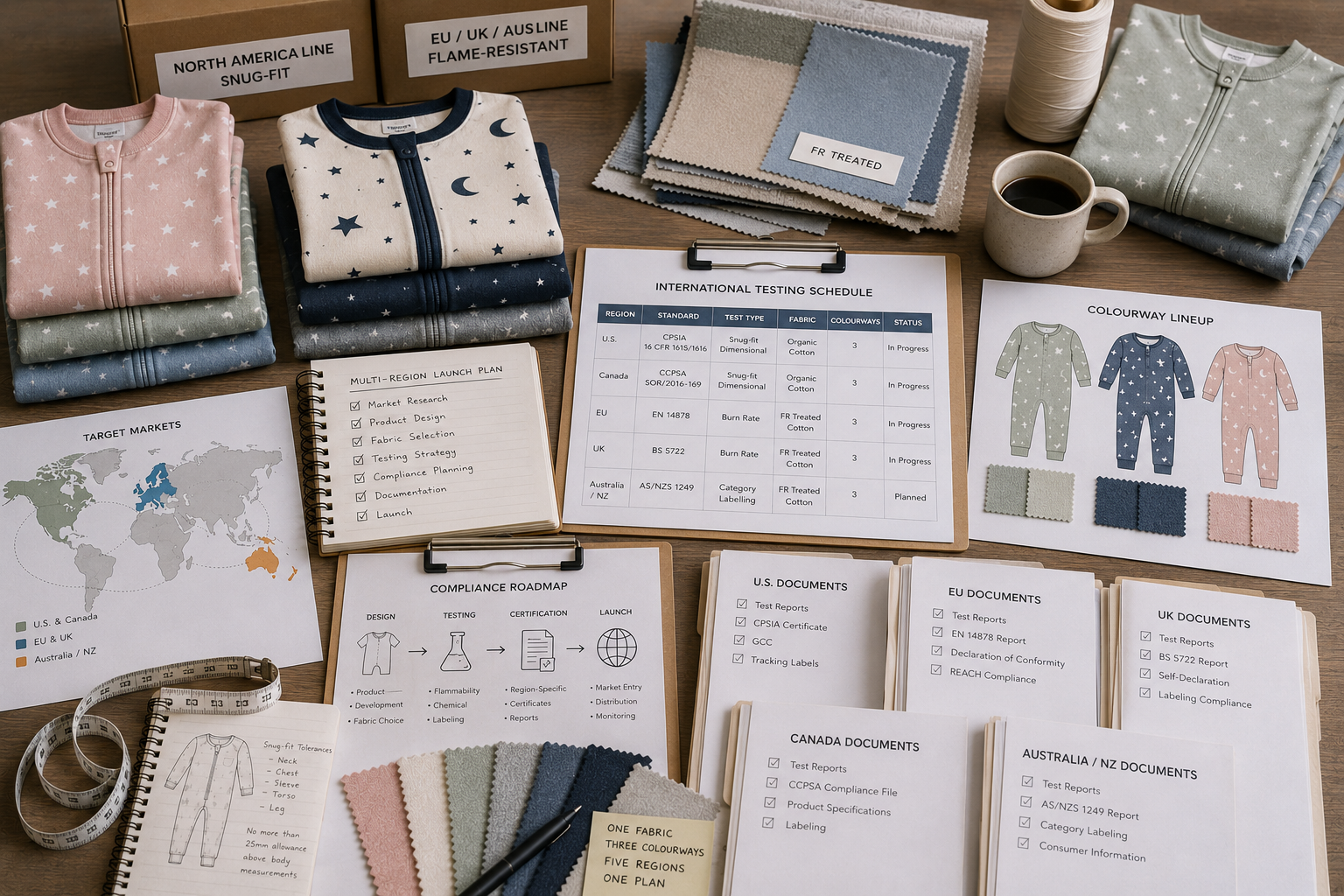
Snug-fit-only brands. U.S. and Canada are easy. EU, UK, AUS/NZ require an FR pathway for the same product or different fabric specs. Many brands run one snug-fit pajama line for North America and a separate FR-treated line for Europe and AUS.
FR-treated brands. Compliant across all regions, but the FR chemistry needs region-specific verification (REACH for EU, EU Ecolabel screening if positioned as eco).
Multi-region testing strategy. Test once per fabric and colour for each region's test. The U.S. snug-fit dimensional report does not satisfy EN 14878. Plan budget accordingly: a multi-region launch with three colourways and U.S./EU/UK/Canada coverage can run $4,000 to $9,000 in lab fees alone.
FAQ
Is U.S. CPSIA snug-fit equivalent to EU EN 14878?
No. CPSIA snug-fit is a dimensional pathway; EN 14878 is a burn-rate pathway. A garment compliant under CPSIA snug-fit does not automatically satisfy EN 14878. Separate testing is required.
Can one production run cover U.S., Canada, EU, and UK?
Yes if the design and fabric pass all four standards. Practically, this almost always means using an FR-treated fabric, since snug-fit doesn't satisfy EU or UK. Brands running snug-fit pajamas typically split production between a North American line and a European line.
What's the cheapest multi-region pathway?
For brands committed to snug-fit (chemical-free positioning), the cheapest pathway is U.S. and Canada only, then licensing the design to an EU partner who handles their own FR-treated production. For brands open to FR, a single FR-treated specification can cover all regions with one fabric construction.
Do I need separate certificates for each region?
Yes. The U.S. GCC, EU Declaration of Conformity, UK self-declaration, and Canadian compliance file are all separate documents tied to region-specific test reports.
Is OEKO-TEX 100 required in the EU?
Not legally, but it is functionally required by most EU retailers as a chemical-safety baseline. Plan for it as a default rather than an option.